
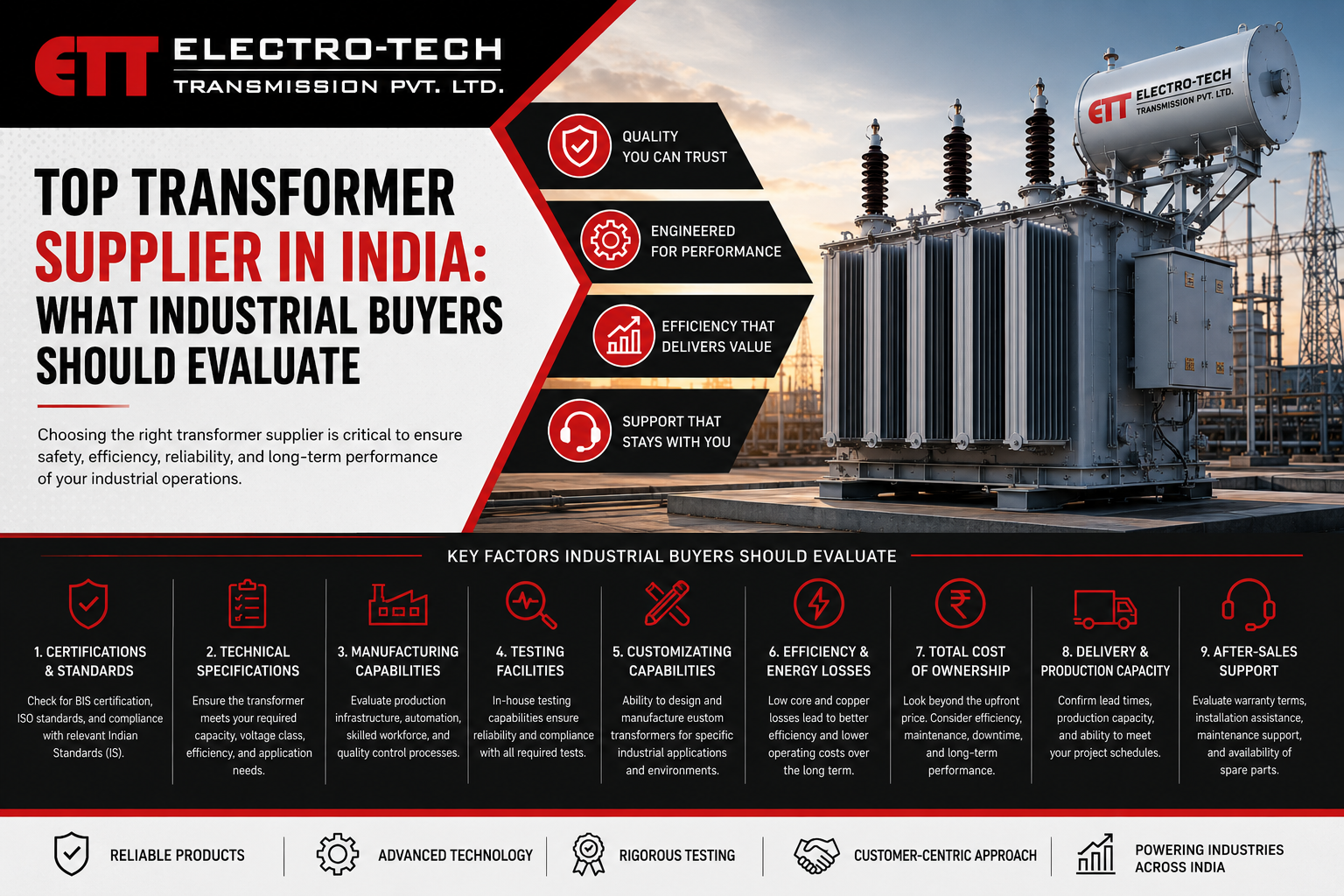
Choosing a top transformer supplier in India should not be based on brand claims, years in business, or the lowest quotation alone. Industrial buyers should compare suppliers using measurable factors such as applicable standards, technical suitability, transformer range, manufacturing infrastructure, testing capability, energy losses, customization, relevant project experience, production capacity, delivery commitments, warranty, and after-sales support.
For procurement managers, EPC contractors, electrical consultants, plant managers, project engineers, and facility managers, the objective is to identify a supplier that can deliver the correct transformer for the application and support it throughout the project lifecycle.
A supplier offering the lowest purchase price may not necessarily provide the lowest total cost if the transformer has higher energy losses, inadequate specifications, weak warranty coverage, or limited post-installation support.
What Should Industrial Buyers Evaluate When Choosing a Transformer Supplier in India?
Industrial buyers should evaluate a transformer supplier across technical compliance, transformer range, application expertise, manufacturing capability, testing, energy efficiency, customization, similar-project experience, delivery reliability, warranty, and after-sales service. These factors should be verified through technical documents, test records, certificates, drawings, references, and written commercial commitments.
The main evaluation criteria are:
- Applicable Indian Standards and BIS requirements
- Transformer range and technical suitability
- Engineering and application expertise
- Manufacturing and quality-control capabilities
- Transformer testing facilities
- Guaranteed efficiency and loss values
- Customization capability
- Relevant project experience
- Production capacity and delivery reliability
- Warranty and lifecycle support
A strong supplier should be able to substantiate its claims rather than relying on general statements such as “high quality,” “BIS compliant,” or “energy efficient.”
What Certifications, BIS Requirements, and Indian Standards Should a Transformer Supplier Comply With?
The applicable Indian Standard and certification requirement depend on the transformer category. BIS identifies the IS 2026 series for power transformers and the IS 1180 series for distribution transformers. Buyers should verify the specific standard, current certification requirement, and supporting documentation for the transformer they intend to purchase.
For power transformers, IS 2026 (Part 1):2011 covers general requirements including service conditions, ratings, and tests. The IS 2026 series also contains separate parts addressing matters such as temperature rise, dielectric testing, short-circuit withstand capability, loading, dry-type transformers, and specialized applications.
For distribution transformers, the applicable IS 1180 requirements depend on the transformer type and scope. Buyers should not assume that one standard or certification automatically applies to every transformer category.
The Bureau of Indian Standards’ Know Your Standard service is especially useful because it provides access to the standard, amendments, gazette notifications, testing schemes, licence information, and laboratories associated with a selected Indian Standard.
Therefore, instead of asking only:
“Is this transformer BIS compliant?”
buyers should ask:
“Which exact Indian Standard applies to this transformer, does compulsory BIS certification apply, and can you provide the relevant licence and compliance documentation?”
ETT’s certification and compliance information can also be reviewed when evaluating its products.
How Should Buyers Evaluate the Supplier’s Transformer Range and Technical Specifications?
A transformer supplier should offer a product that matches the actual electrical system and application rather than simply recommending the nearest available kVA rating. Buyers should evaluate capacity, voltage ratio, frequency, impedance, vector group, tapping requirements, cooling, insulation, temperature rise, load characteristics, and installation conditions.
Important technical parameters include:
| Specification | What Buyers Should Verify |
|---|---|
| kVA/MVA rating | Required capacity and future expansion |
| Primary voltage | Compatibility with incoming supply |
| Secondary voltage | Required utilization voltage |
| Frequency | System frequency |
| Impedance | Voltage regulation and fault-current requirements |
| Vector group | Winding connection and phase displacement |
| Tap range | Required voltage-adjustment capability |
| Cooling | Suitability for duty and environment |
| Insulation | Voltage level and environmental suitability |
| Temperature rise | Applicable thermal limits |
| Installation | Indoor/outdoor, ambient temperature, altitude and space |
The actual load profile is particularly important.
A factory with large motors, variable-frequency drives, welding loads, furnaces, or harmonic-producing equipment may require a different design from a commercial facility with the same apparent connected load.
Future expansion should also be considered before finalizing capacity.
Which Transformer Type Is Suitable for an Industrial Project?
The correct transformer type depends on the electrical system, operating environment, load behavior, space, voltage-control requirements, and application. Industrial buyers may need distribution, power, dry-type, off-load tap-changing, on-load tap-changing, compact, or furnace transformers depending on project conditions.
For example:
- Distribution transformers are commonly used in electrical distribution systems supplying facilities and end users.
- Power transformers are generally associated with higher-capacity power-system applications.
- Dry-type transformers may suit certain indoor or environmentally sensitive installations.
- Off-load tap-changing transformers require de-energization before tap adjustment.
- On-load tap-changing transformers permit ratio adjustment while energized.
- Compact transformers may help where installation space is restricted.
- Furnace transformers address specialized industrial furnace duties.
Buyers can review ETT’s power transformer, dry-type transformer, off-load transformer, and on-load transformer information when researching these categories.
What Manufacturing Infrastructure and Quality-Control Capabilities Should Buyers Verify?
Buyers should examine whether the supplier or manufacturer has adequate production infrastructure, controlled manufacturing processes, material inspection, documented quality checks, appropriate testing equipment, and sufficient capacity for the required transformer. They should also understand which critical operations are performed internally and which are outsourced.
Relevant manufacturing areas can include:
- Core processing and assembly
- Winding operations
- Insulation processing
- Drying procedures
- Tank fabrication where applicable
- Oil processing for liquid-filled transformers
- Material inspection
- Final assembly
- Quality-control checkpoints
- Electrical testing
In-house manufacturing does not automatically guarantee better quality, just as outsourcing does not automatically indicate lower quality.
The critical question is whether the supplier maintains effective process control, traceability, inspection, and accountability.
For major industrial orders, buyers may consider visiting the manufacturing plant or reviewing detailed infrastructure information.
What Transformer Testing Capabilities Should Buyers Look For?
The supplier should clearly state which routine tests will be performed on the ordered transformer, what relevant type-test documentation is available, whether project-specific special tests are required, and whether Factory Acceptance Testing can be arranged where specified. Testing should be defined before production begins.
Depending on transformer type and applicable standard, relevant tests may include:
- Winding resistance
- Voltage ratio
- Phase displacement/vector group
- No-load loss and current
- Load loss and impedance
- Dielectric tests
- Temperature-rise tests
- Short-circuit withstand requirements
Not every test applies identically to every transformer.
For example, BIS identifies IS 2026 Part 3 with insulation levels and dielectric tests, while IS 2026 Part 5 addresses the ability of applicable power transformers to withstand short circuits.
For significant industrial and EPC projects, buyers may also request Factory Acceptance Testing (FAT) so that agreed tests can be witnessed before dispatch.
Ask suppliers to specify:
- Which tests are included
- Which tests require external laboratories
- Which type-test certificates are available
- Whether FAT can be witnessed
- Which final test certificates will accompany the transformer
How Should Buyers Compare Transformer Efficiency, Losses, and Lifecycle Cost?
Transformer price should be evaluated together with guaranteed no-load losses, load losses, expected loading, operating hours, maintenance requirements, and service conditions. A slightly more expensive transformer may potentially deliver better lifecycle value if its verified operating losses are significantly lower.
No-load loss occurs whenever an energized transformer is operating, even when the load is low.
Load loss varies with the current flowing through the transformer.
Consider this simplified example:
| Transformer A | Transformer B | |
|---|---|---|
| Purchase price | ₹15 lakh | ₹15.5 lakh |
| No-load losses | 1.9 kW | 1.5 kW |
| Load losses | 11 kW | 9.5 kW |
| Initial difference | — | ₹50,000 higher |
The table alone still does not establish which transformer is cheaper over its life.
The buyer would need to calculate electricity costs using the expected loading pattern, operating hours, applicable tariff, and anticipated service period.
If Transformer B produces sufficiently lower losses under the real operating profile, the additional ₹50,000 purchase cost could potentially be recovered through lower energy costs.
This is why buyers evaluating energy-efficient transformers in Indore, MP, or elsewhere should request guaranteed numerical loss values, not merely an “energy-efficient” label.
When Should Businesses Choose a Customized Transformer?
Customized transformers are appropriate when standard designs cannot meet the project’s electrical, mechanical, environmental, space, control, or operating requirements. Suppliers should be able to explain why customization is necessary and how the modified specification addresses the actual application.
Customization may be useful for:
- Industrial plants with unusual loads
- Foundries and furnace applications
- Solar and wind installations
- Healthcare facilities
- Commercial developments
- Specialized engineering machinery
- Restricted installation areas
- Unusual voltage ratios
- Special tap ranges
- Challenging ambient conditions
- Additional monitoring or accessories
For instance, a foundry application can involve operating characteristics significantly different from standard commercial distribution.
Likewise, solar power installations may require project-specific transformer engineering.
A competent supplier should be able to modify ratings, voltage ratios, tapping arrangements, cooling, enclosure, dimensions, or accessories when technically justified.
How Should Buyers Evaluate Production Capacity and Delivery Timelines?
A credible transformer supplier should provide a realistic schedule covering engineering approval, material procurement, manufacturing, testing, FAT or inspection, dispatch, transportation, and commissioning where applicable. Buyers should establish exactly when the quoted lead time begins and what events could affect it.
A quotation stating “delivery in eight weeks” is incomplete unless the starting point is clear.
Is it eight weeks from:
- Purchase order?
- Advance payment?
- Technical-data approval?
- Drawing approval?
- Manufacturing clearance?
Industrial buyers should also ask about the supplier’s current production load, availability of critical materials, FAT scheduling, transportation responsibility, and commissioning requirements.
Unusually short promises should be validated against actual production capacity.
How Should Buyers Compare Warranty and After-Sales Support?
Warranty evaluation should include more than its duration. Buyers should understand coverage, exclusions, repair and replacement procedures, commissioning support, troubleshooting, spare-parts availability, response mechanisms, transportation responsibility, and technical assistance after installation.
Ask questions such as:
- When does the warranty begin?
- What components are covered?
- What exclusions apply?
- Who investigates a failure?
- How are repairs handled?
- When is replacement considered?
- Is commissioning assistance available?
- Are critical spare parts available?
- Is field technical support offered?
- Who bears transportation costs for warranty repairs?
After-sales capability becomes particularly important when transformer downtime can interrupt industrial production.
Transformer Supplier Evaluation Table
| Evaluation Factor | What to Verify | Why It Matters | Potential Red Flags |
|---|---|---|---|
| Compliance | Applicable IS/BIS evidence | Regulatory and technical suitability | Generic compliance claims |
| Product range | Correct transformer category | Application fit | One product recommended for every use |
| Specifications | Complete technical datasheet | Prevents mismatch | Missing impedance/loss data |
| Manufacturing | Processes and capacity | Quality and execution | Limited manufacturing information |
| Testing | Test facilities and reports | Verifies performance | Missing documentation |
| Efficiency | Guaranteed loss values | Lifecycle cost | Only “high-efficiency” claims |
| Customization | Engineering capability | Specialized applications | Changes without calculations |
| Experience | Similar applications | Technical familiarity | Only broad client lists |
| Delivery | Written schedule | Project planning | Unrealistic commitments |
| Warranty | Coverage and procedure | Risk protection | Vague warranty terms |
| Service | Commissioning, spares, support | Lifecycle reliability | No clear support process |
| Price | Equivalent technical scope | Fair comparison | Unusually low unexplained bid |
Transformer Supplier Red Flags
Industrial buyers should investigate further when they encounter:
- Unclear BIS or standards documentation
- Missing relevant test certificates
- Technical quotations with major parameters omitted
- No guaranteed loss values
- Very low prices without technical explanation
- No evidence of experience with the required transformer category
- Reluctance to discuss manufacturing or testing
- Unrealistic delivery schedules
- Undefined FAT arrangements
- Broad efficiency or reliability claims without evidence
- Vague warranty language
- No clear post-installation service procedure
A red flag does not automatically mean the supplier should be rejected, but it should trigger additional due diligence.
What Documents Should Buyers Request Before Placing an Order?
Before issuing the purchase order, obtain:
- Final technical datasheet
- Approved drawings where applicable
- Applicable Indian Standard details
- Relevant BIS licence/certification information where required
- Guaranteed no-load and load losses
- Test plan
- Relevant type-test documentation
- FAT/inspection requirements
- Final accessories list
- Commercial quotation
- Payment terms
- Delivery commitment
- Transportation responsibilities
- Warranty terms
- Installation/commissioning scope
- After-sales support terms
These documents should align with the final purchase-order specification.
Industrial Transformer Supplier Evaluation Checklist
Procurement teams can score competing suppliers from 1 to 5 for each category.
| Evaluation Area | Score /5 |
|---|---|
| Standards and compliance | __ |
| BIS documentation where applicable | __ |
| Transformer range | __ |
| Technical engineering capability | __ |
| Manufacturing infrastructure | __ |
| Quality-control processes | __ |
| Testing capability | __ |
| Efficiency/loss performance | __ |
| Customization capability | __ |
| Similar-project experience | __ |
| Production capacity | __ |
| Delivery reliability | __ |
| Warranty terms | __ |
| Commissioning and service | __ |
| Lifecycle-cost competitiveness | __ |
| Total /75 | __ |
The scorecard should support—not replace—engineering judgment. Critical technical non-compliance should not be overlooked simply because a supplier achieves a high overall numerical score.
Final Thoughts
Choosing a Top Transformer Supplier in India should be based on documented technical capability and lifecycle value rather than marketing claims or purchase price alone.
A strong evaluation process should answer four questions:
Is the proposed transformer technically suitable?
Can the supplier demonstrate applicable compliance, manufacturing, and testing capability?
Can the supplier deliver the transformer within the required project schedule?
Will the supplier provide adequate support throughout the transformer lifecycle?
For industrial buyers comparing a Transformer Supplier in India, Distribution Transformer Manufacturer in India, or supplier of specialized industrial transformers, these questions provide a stronger procurement framework than ranking companies solely by price, brand visibility, or years in business.
Frequently Asked Questions
What should I check before choosing a transformer supplier in India?
Verify the applicable standards, technical specifications, BIS requirements where applicable, manufacturing capability, testing facilities, guaranteed losses, customization ability, project experience, delivery capacity, warranty, and after-sales service.
How can I verify a supplier’s BIS compliance?
Identify the applicable Indian Standard first, then use official BIS resources to review the standard, certification information, licence records, testing schemes, and related documentation. BIS’s Know Your Standard portal provides access to these resources.
What technical specifications should be included in a transformer quotation?
A detailed quotation should specify capacity, primary and secondary voltage, frequency, impedance, vector group, tapping arrangement, cooling, insulation, temperature-rise requirements, guaranteed losses, accessories, applicable standards, and relevant installation conditions.
Is the lowest-priced transformer usually the best choice?
Not necessarily. Buyers should compare technically equivalent transformers and consider guaranteed losses, efficiency, maintenance, testing, warranty, delivery, reliability considerations, and after-sales service together with the purchase price.
When should I request Factory Acceptance Testing?
FAT may be appropriate when required by the project specification, purchaser, consultant, or EPC contract. The agreed FAT scope and witness arrangements should be documented before manufacturing or testing begins.
Why should industrial buyers consider lifecycle cost?
Transformer lifecycle cost includes more than the purchase price. Energy losses, maintenance, service requirements, downtime exposure, and operating conditions can materially influence the total cost of owning and operating a transformer.