
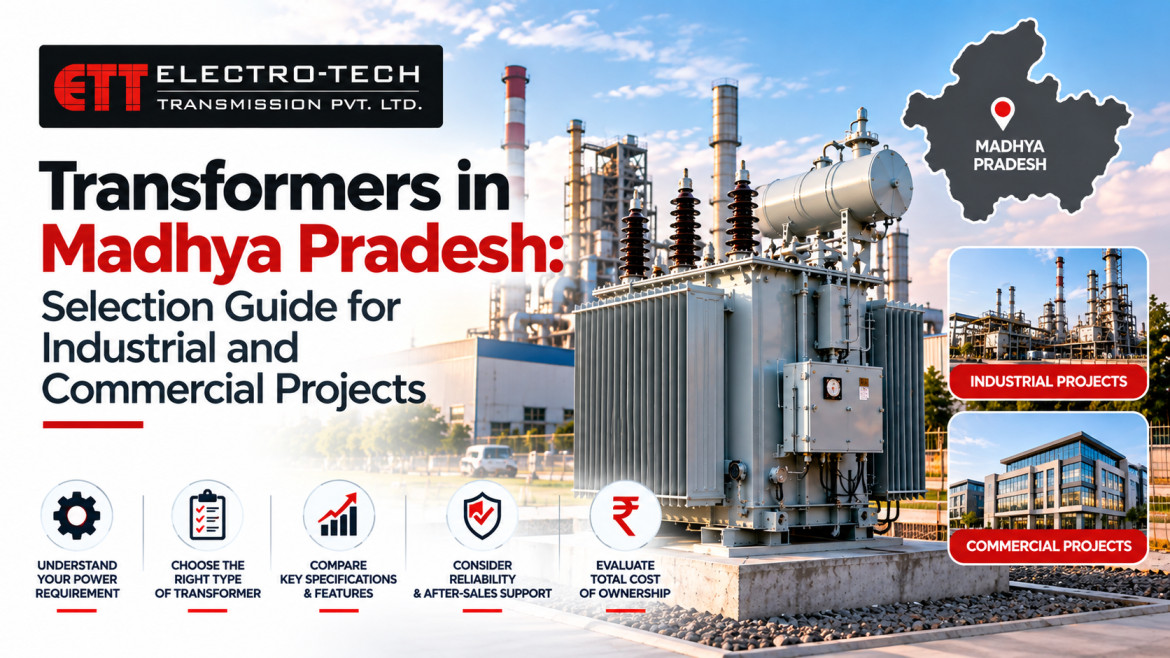
Transformers are an essential part of electrical infrastructure for factories, commercial buildings, warehouses, and infrastructure projects. Choosing the right transformer helps businesses meet their power requirements while managing energy losses, operating costs, and long-term maintenance.
For businesses planning new installations or expanding existing facilities, selecting suitable transformers in Madhya Pradesh requires careful evaluation of electrical load, voltage requirements, operating conditions, and project specifications.
This guide explains the key factors industrial and commercial buyers should consider before selecting a transformer.
1. Understand Your Project’s Electrical Requirements
Before approaching a transformer supplier, identify the electrical requirements of the proposed installation. Selecting equipment without an accurate load assessment can result in an unsuitable transformer rating or unnecessary expenditure.
Start by evaluating:
- Total connected electrical load.
- Maximum expected demand.
- Primary and secondary voltage requirements.
- Single-phase or three-phase configuration, where applicable.
- Motor starting currents and fluctuating loads.
- Expected future expansion.
- Site conditions and operating environment.
For example, a manufacturing facility operating heavy machinery may have different electrical requirements from an office complex or retail building. The transformer must be selected according to the actual load profile rather than the building’s size alone.
A qualified electrical engineer should calculate the required rating and confirm the final specifications.
2. Choose the Right Type of Transformer
Different applications require different transformer designs. Understanding the main categories helps buyers identify the appropriate equipment.
Distribution Transformers
Distribution transformers reduce voltage to levels suitable for downstream electrical distribution. They are commonly used in industrial facilities, commercial complexes, and distribution networks.
When evaluating a distribution transformer manufacturer in Madhya Pradesh, compare the available ratings, voltage ratios, cooling arrangements, efficiency, and protection requirements.
Explore the ETT distribution transformer range to review the relevant product category.
Power Transformers
Power transformers are generally used in higher-capacity electrical networks, including substations and large industrial power systems.
Selection considerations include rated capacity, voltage levels, cooling arrangements, insulation, operating conditions, and the testing requirements specified for the project.
ETT also lists power transformers for buyers evaluating equipment for larger electrical installations.
Industrial Transformers
Industrial applications may require transformers designed around specific machinery, production processes, or electrical distribution arrangements.
The correct model depends on the installation’s load characteristics and technical requirements. Buyers should share detailed specifications with suppliers rather than relying solely on general product descriptions.
3. Calculate the Required Transformer Capacity
Transformer capacity is generally expressed in kilovolt-amperes (kVA) or megavolt-amperes (MVA).
Capacity selection should account for the expected electrical demand, power factor, load variations, and equipment starting characteristics. It should also consider reasonable provision for planned expansion.
For a three-phase system, the apparent power can be estimated using:
[
\text{kVA}=\frac{\sqrt{3}\times V\times I}{1000}
]
Here, (V) represents line-to-line voltage in volts and (I) represents line current in amperes.
This calculation can help estimate apparent power when the electrical parameters are known. However, final transformer sizing requires a proper load assessment and consideration of the system design.
Choosing an undersized transformer may limit operational flexibility, while excessive capacity can increase initial procurement costs and affect operating efficiency under certain loading conditions.
4. Compare Transformer Efficiency and Operating Costs
Energy efficiency is an important consideration when purchasing transformers for facilities that operate for long hours.
Transformers experience two main categories of losses:
- No-load losses: Occur whenever the transformer is energised, even with little or no load.
- Load losses: Generally increase as the transformer carries more electrical load.
Businesses comparing energy-efficient transformers in Madhya Pradesh should request guaranteed loss figures from shortlisted manufacturers.
Consider the following factors:
- Expected annual operating hours.
- Typical and peak transformer loading.
- Guaranteed no-load and load losses.
- Electricity tariffs.
- Purchase price and expected service life.
- Maintenance and operating requirements.
A model with lower losses may offer long-term savings, especially in continuously operating facilities. The actual benefit depends on the load profile, energy costs, and difference in purchase price.
5. Evaluate Transformer Manufacturers and Suppliers
Choosing a supplier requires more than comparing quotations. The equipment must satisfy the project’s specifications and come with appropriate documentation and support.
Before selecting a transformer manufacturer in India, review these areas.
Technical capability: Confirm that the manufacturer can supply equipment matching your required capacity, voltage ratio, cooling method, and other specifications.
Quality and compliance: Verify applicable Indian Standards, project-specific requirements, and relevant quality documentation.
Testing: Request the necessary test reports, drawings, and technical datasheets. Confirm any additional testing or inspection requirements before ordering.
Warranty: Review the warranty period, coverage, exclusions, and process for reporting technical issues.
After-sales support: Ask about installation guidance, commissioning support, maintenance, and technical assistance.
Delivery timelines: Ensure that manufacturing, transportation, and delivery schedules align with the project plan.
Comparing suppliers using the same technical specification sheet makes quotations easier to evaluate fairly.
6. Consider Installation and Site Conditions
A transformer must be suitable not only for the electrical load but also for the installation environment.
Before finalising a model, consider:
- Indoor or outdoor installation.
- Ambient temperature and ventilation.
- Available installation space and clearances.
- Earthing and electrical protection requirements.
- Cooling and access for maintenance.
- Applicable fire and electrical safety requirements.
Oil-filled and dry-type transformers have different installation and maintenance considerations. The choice should be based on the project’s design, site conditions, and applicable requirements.
Installation and commissioning should be carried out by qualified personnel following the approved electrical design and the manufacturer’s instructions.
7. Plan for Maintenance and Long-Term Reliability
Regular inspection and appropriate maintenance help support reliable transformer operation.
The maintenance programme should reflect the transformer type, loading conditions, operating environment, and manufacturer recommendations.
Typical considerations include:
- Monitoring operating temperature and loading.
- Inspecting connections and accessible components.
- Checking for unusual noise, vibration, or overheating.
- Inspecting for oil leakage where applicable.
- Following recommended electrical testing and inspection schedules.
- Maintaining service records and test documentation.
Buyers should understand the expected maintenance requirements before purchase, particularly when the transformer supports critical manufacturing processes or commercial operations.
8. Finding Transformers in Madhya Pradesh
Businesses searching for transformers in Madhya Pradesh should begin by identifying the project’s technical requirements and comparing suitable products from qualified suppliers.
Use the following checklist when evaluating options:
- Confirm the required transformer capacity and voltage ratio.
- Identify the appropriate transformer type and cooling arrangement.
- Compare guaranteed losses and expected operating costs.
- Verify applicable standards and testing documentation.
- Review warranty and after-sales support.
- Confirm delivery timelines and total procurement costs.
ETT Groups lists distribution and power transformers in its product portfolio. Businesses can review the ETT products and services page and contact the company to discuss their project requirements.
Confirm current product specifications, availability, warranty terms, and delivery arrangements directly with the supplier before purchasing.
Frequently Asked Questions
1. How do I select a transformer for an industrial project?
Assess the connected load, maximum demand, voltage requirements, power factor, motor starting currents, and future expansion plans. A qualified electrical engineer should confirm the capacity and final technical specifications.
2. Which transformer is suitable for commercial buildings?
The appropriate transformer depends on the building’s electrical demand, incoming supply, distribution arrangement, installation environment, and applicable requirements. Distribution transformers are commonly used where voltage reduction is required for downstream distribution.
3. Why should I compare transformer losses before buying?
No-load and load losses contribute to energy consumption during operation. Comparing guaranteed losses alongside purchase price can help businesses evaluate long-term operating costs.
4. What documents should I request from a transformer supplier?
Depending on the project, request technical datasheets, drawings, applicable compliance documentation, relevant test reports, warranty information, and installation or maintenance instructions.
5. How can I compare transformer suppliers in Madhya Pradesh?
Provide each shortlisted supplier with the same technical specifications. Compare product suitability, guaranteed losses, documentation, warranty, delivery schedule, and after-sales support alongside price.
Conclusion
Selecting a transformer for an industrial or commercial project requires a clear understanding of electrical demand, capacity, voltage requirements, efficiency, installation conditions, and maintenance needs.
Businesses evaluating transformers in Madhya Pradesh should compare products against consistent technical criteria and assess long-term operating costs rather than focusing only on the initial purchase price.
Explore the ETT transformer product range to review available options and discuss the requirements of your industrial or commercial project.