
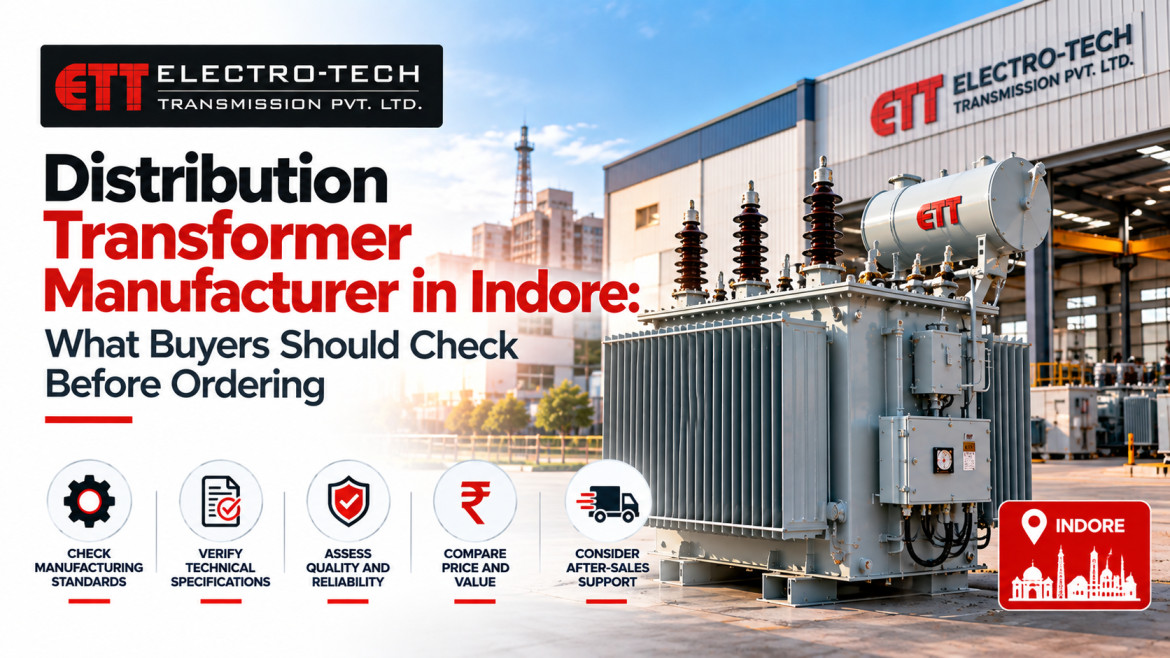
Distribution transformers are an important part of electrical infrastructure for factories, commercial buildings, industrial parks, and other facilities. They help reduce voltage to levels suitable for downstream electrical distribution, supporting the reliable operation of connected equipment.
For businesses looking for a distribution transformer manufacturer in Indore, choosing the right supplier involves more than comparing prices. Buyers need to evaluate technical specifications, efficiency, quality documentation, installation requirements, and after-sales support before placing an order.
This guide covers the key factors to check when purchasing a distribution transformer for an industrial or commercial project.
1. Confirm the Required Transformer Capacity
The first step is determining the transformer capacity required for the installation. Capacity is generally measured in kilovolt-amperes (kVA).
An undersized transformer may struggle to meet demand, while an unnecessarily large unit can increase initial procurement costs and may not operate as efficiently under certain loading conditions.
Before requesting quotations, consider:
- Total connected electrical load.
- Maximum expected demand.
- Power factor.
- Motor starting currents and fluctuating loads.
- Expected future expansion.
- Operating hours and load patterns.
For example, a manufacturing facility operating multiple motors may have different requirements from a warehouse or commercial office building.
A qualified electrical engineer should assess the load and confirm the appropriate transformer rating.
2. Check Voltage and Technical Specifications
A transformer must match the electrical system in which it will operate. Even when two models have the same capacity, their voltage ratings, cooling arrangements, and other specifications may differ.
Before ordering, confirm:
- Primary and secondary voltage ratings.
- Rated capacity in kVA.
- Frequency and phase configuration.
- Cooling method.
- Insulation and temperature-rise requirements.
- Required accessories and protection arrangements.
- Indoor or outdoor installation suitability.
Provide the manufacturer with a clear technical specification sheet so the proposed equipment can be evaluated against your project’s requirements.
Businesses comparing transformers in Indore should ensure that quotations are based on the same specifications to make the comparison meaningful.
3. Compare Energy Efficiency and Transformer Losses
Transformer efficiency affects operating costs over the equipment’s service life.
Two important loss categories are:
- No-load losses: Occur when the transformer is energised, even when it supplies little or no load.
- Load losses: Generally increase as the transformer carries more electrical load.
When comparing distribution transformers, request guaranteed no-load and load-loss figures from the manufacturer.
Also consider the expected operating hours, typical loading, electricity tariff, and purchase price. A transformer with lower losses may offer long-term savings, particularly in facilities that operate continuously.
Buyers looking for energy-efficient transformers in Madhya Pradesh should compare losses under consistent technical and testing conditions rather than relying on general efficiency claims alone.
4. Verify Applicable Standards and Testing
A distribution transformer should meet the applicable standards and the technical requirements specified for the project.
Before placing an order, ask the manufacturer for relevant documentation, such as:
- Technical datasheets and approved drawings.
- Applicable standards and compliance documentation.
- Routine test reports.
- Details of any required additional or type tests.
- Inspection and quality-control procedures.
- Warranty documentation.
The exact requirements depend on the transformer design, application, and project specifications.
Confirm that the proposed model meets the required standards before manufacturing or dispatch. If the project requires customer inspection or third-party testing, agree on the procedure with the supplier in advance.
5. Evaluate the Manufacturer’s Technical Capability
Not every manufacturer offers the same product range, customisation options, or technical support.
When evaluating a distribution transformer manufacturer in India, consider whether the supplier can meet your project’s capacity, voltage, cooling, and documentation requirements.
Ask questions about:
- Available transformer ratings and configurations.
- Manufacturing and quality-control processes.
- Technical support during specification and ordering.
- Testing facilities and documentation.
- Experience with comparable applications.
- Availability of service and replacement components.
ETT Groups lists distribution transformers in its product portfolio. Buyers can review the ETT distribution transformer range and contact the company to discuss their technical requirements.
Verify current product specifications and availability directly with the supplier before making a purchasing decision.
6. Check Installation and Site Requirements
The suitability of a transformer depends on both its electrical specifications and the conditions at the installation site.
Before ordering, consider:
Installation location: Confirm whether the unit will be installed indoors or outdoors and whether its enclosure and design are suitable for the environment.
Ventilation and clearances: Ensure there is sufficient space for cooling, inspection, and maintenance.
Earthing and protection: Confirm the requirements for grounding, protective devices, and electrical connections with the project’s electrical designer.
Access and transportation: Check the dimensions, weight, unloading arrangements, and access route to the installation location.
Maintenance access: Ensure that technicians can safely inspect and service the transformer.
Discuss site-specific requirements with the manufacturer and project engineer before finalising the order.
7. Review Warranty, Delivery, and After-Sales Support
A transformer is a long-term investment, so buyers should review the commercial terms alongside the technical specifications.
Before ordering, confirm:
- Warranty duration and coverage.
- Conditions that may exclude warranty claims.
- Manufacturing and delivery timelines.
- Payment and inspection terms.
- Installation or commissioning support, if offered.
- Maintenance recommendations.
- The process for reporting technical issues.
A lower quotation may not represent better value if it excludes important accessories, documentation, testing, or required support.
Compare the total quoted cost for equipment that meets the same technical requirements.
8. How to Compare Distribution Transformer Quotations
Use a standard checklist to compare offers from shortlisted manufacturers.
| Comparison factor | What to verify |
|---|---|
| Capacity | Required kVA rating |
| Voltage | Primary and secondary ratings |
| Technical design | Cooling, insulation, and accessories |
| Efficiency | Guaranteed no-load and load losses |
| Standards | Applicable compliance requirements |
| Testing | Required reports and inspection arrangements |
| Warranty | Duration, coverage, and exclusions |
| Delivery | Manufacturing and dispatch timeline |
| Support | Technical assistance and service availability |
| Price | Total cost for the specified equipment |
This approach helps industrial and commercial buyers evaluate quotations consistently and identify differences that may otherwise be overlooked.
Frequently Asked Questions
1. What should I check before ordering a distribution transformer?
Check the capacity, voltage ratings, cooling method, efficiency, applicable standards, testing documentation, warranty, delivery schedule, and installation requirements.
2. How do I choose a distribution transformer manufacturer in Indore?
Prepare a technical specification sheet and compare manufacturers based on their ability to meet your requirements, relevant documentation, quality assurance, warranty, and after-sales support.
3. Why are transformer losses important?
No-load and load losses contribute to energy consumption during operation. Comparing guaranteed loss figures can help buyers estimate long-term operating costs.
4. What documents should I request from a transformer manufacturer?
Depending on the project, request technical datasheets, drawings, applicable compliance documentation, test reports, warranty terms, and installation and maintenance instructions.
5. Can I select a transformer based only on its kVA rating?
No. Capacity is only one selection factor. Voltage, load characteristics, cooling, efficiency, site conditions, and applicable project requirements must also be considered.
Conclusion
Choosing a distribution transformer requires careful evaluation of technical requirements, efficiency, testing, installation conditions, and long-term support.
Businesses searching for a distribution transformer manufacturer in Indore should prepare clear specifications, compare quotations on a like-for-like basis, and verify the manufacturer’s documentation before ordering.
Explore the ETT distribution transformer range to review available options and discuss your industrial or commercial project’s requirements with the supplier.