
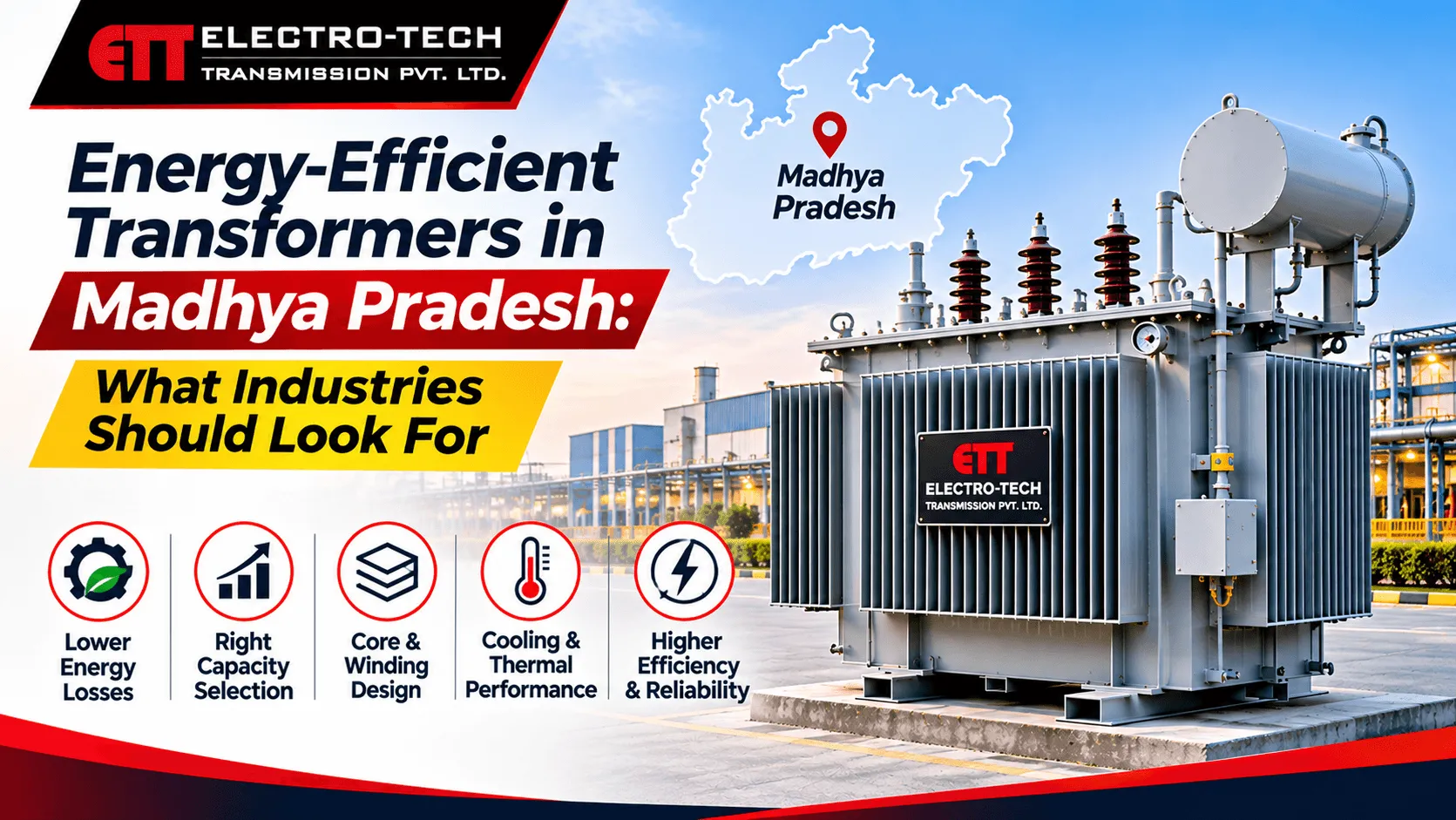
Electricity is one of the most important operating requirements for industrial facilities. Manufacturing plants, engineering units, processing industries and large commercial facilities depend on reliable electrical infrastructure to maintain production and manage operating expenses.
One important component of this infrastructure is the power transformer.
Transformers operate for long periods and consume energy through electrical losses, even though their primary purpose is to transfer electrical power between different voltage levels. Selecting an energy-efficient transformer can help industries reduce avoidable energy losses and improve the performance of their electrical distribution systems.
For industrial businesses in Madhya Pradesh, choosing the right transformer requires more than comparing purchase prices or kVA ratings. Factors such as load requirements, operating hours, no-load losses, load losses, cooling arrangements and installation conditions all influence long-term efficiency.
So, what should industries look for when purchasing an energy-efficient transformer?
This guide explains the important technical considerations and practical steps businesses should follow when selecting transformers for industrial facilities in Madhya Pradesh.
1. Why Energy Efficiency Matters in Industrial Transformers
A transformer is designed to transfer electrical energy from one circuit to another through electromagnetic induction.
However, not all the electrical energy entering a transformer reaches the output. A portion is lost during operation.
These losses generate heat and contribute to the overall energy consumption of the electrical distribution system.
Even relatively small transformer losses can become significant when equipment operates continuously over extended periods.
For industrial facilities, improving transformer efficiency can help:
- Reduce unnecessary electrical energy losses.
- Lower long-term operating expenses.
- Improve electrical distribution performance.
- Reduce avoidable heat generation.
- Support better energy management.
- Improve the overall efficiency of industrial infrastructure.
The Bureau of Energy Efficiency (BEE) recommends selecting transformers based on actual plant loading requirements and their best efficiency points rather than choosing capacity based only on connected load.
This makes proper transformer selection an important part of industrial energy conservation.
2. Understand the Two Main Types of Transformer Losses
Before purchasing an energy-efficient transformer, industries should understand the two major categories of electrical losses.
No-Load Losses
No-load losses occur when a transformer is energised, even when it is not supplying a significant electrical load.
These losses are primarily associated with the transformer core and are also called iron losses or core losses.
They are influenced by factors such as:
- Core material.
- Magnetic flux density.
- Core construction.
- Operating voltage and frequency.
Since no-load losses continue whenever the transformer remains energised, they are particularly important for industrial facilities that operate transformers for extended periods.
Choosing a transformer with lower guaranteed no-load losses can help reduce energy consumption over its operating life.
Load Losses
Load losses occur when electrical current flows through the transformer windings.
They are commonly associated with winding resistance and are also referred to as copper losses.
Load losses increase with the square of the current under comparable operating conditions.
This means that higher transformer loading generally results in greater load losses.
Winding material, conductor dimensions, transformer design and operating temperature influence these losses.
When comparing transformer options, industrial buyers should examine both no-load and load losses rather than focusing on only one efficiency parameter.
3. Choose the Right Transformer Capacity for Your Plant
Selecting the correct transformer capacity is one of the most important steps in improving energy efficiency.
An undersized transformer may experience excessive loading, higher temperatures and operational problems.
An oversized transformer may operate at a relatively low loading level, while its no-load losses continue whenever it remains energised.
Neither situation is ideal.
Industries should begin by preparing a detailed electrical load assessment.
Consider:
- Total connected equipment.
- Actual maximum demand.
- Operating power factor.
- Number of machines running simultaneously.
- Production schedules.
- Seasonal load variations.
- Planned future expansion.
The transformer should be selected according to the plant’s actual demand and expected operating profile.
The BEE’s industrial energy conservation guidelines specifically recommend assessing routine and seasonal loading patterns and selecting the transformer size and number of units around their best efficiency points.
This approach helps industries avoid unnecessary oversizing and improve transformer utilisation.
4. Look for Transformers With Lower No-Load Losses
For facilities where transformers remain energised continuously, no-load losses deserve particular attention.
A transformer may operate at a relatively low load during certain production periods, but its core losses continue even when electricity demand is limited.
This makes core material and construction important factors during procurement.
Amorphous Core Transformers
Amorphous metal core transformers are designed to reduce magnetic core losses compared with conventional core designs.
The material has different magnetic characteristics that can help reduce energy lost during magnetisation and demagnetisation.
They may be worth evaluating for applications where transformers remain energised for long periods and operate at varying load levels.
However, buyers should compare the guaranteed no-load losses, load losses, initial cost and expected operating profile before deciding.
The BEE also identifies low no-load loss transformers, including amorphous core options, as an energy conservation consideration for industrial installations.
5. Evaluate Load Losses and Winding Design
While core losses are important, winding losses also influence transformer efficiency.
These losses depend on the current flowing through the windings and the resistance of the conductors.
A well-designed winding system helps manage electrical resistance, heating and overall performance.
When evaluating an industrial transformer, consider:
- Winding material.
- Conductor cross-sectional area.
- Winding arrangement.
- Current-carrying capacity.
- Temperature-rise limits.
- Short-circuit withstand capability.
Copper and aluminium are both used in transformer windings.
The selection depends on the transformer design, electrical requirements, cost and performance considerations.
Rather than choosing a transformer based only on the winding material, compare its guaranteed load losses and complete technical specifications.
This provides a more useful basis for evaluating efficiency.
6. Consider the Type of Transformer Suitable for Your Industrial Facility
The installation environment influences transformer construction and cooling requirements.
Oil-immersed and dry-type transformers are commonly considered for industrial applications.
Oil-Immersed Transformers
Oil-immersed transformers use insulating oil for electrical insulation and heat transfer.
They are commonly used in industrial substations and outdoor electrical installations.
Important considerations include:
- Cooling performance.
- Oil quality and condition.
- Installation environment.
- Fire-safety provisions.
- Oil containment arrangements.
- Maintenance requirements.
They may be suitable for facilities where the installation design supports oil-filled electrical equipment.
Dry-Type Transformers
Dry-type transformers use air or solid insulation systems rather than insulating oil.
They may be considered for indoor electrical rooms and locations where oil containment requires additional arrangements.
Important considerations include:
- Ventilation.
- Ambient temperature.
- Dust and moisture exposure.
- Enclosure protection.
- Installation space.
- Cooling requirements.
The most suitable transformer type depends on the application, safety requirements and installation conditions.
Industries should compare actual guaranteed losses for the proposed transformer designs instead of assuming that one construction type is always more efficient than another.
7. Consider Power Factor and Harmonic Distortion
Industrial facilities often use motors, compressors, pumps and electronic equipment.
These loads can influence the electrical power factor and introduce harmonic distortion.
Power Factor
Power factor describes the relationship between real power and apparent power.
A low power factor means that more apparent power is required to deliver the same amount of useful real power.
This can increase current and contribute to higher electrical losses in the distribution system.
Suitable power factor correction arrangements, such as capacitor banks, may help improve the plant’s electrical performance.
However, correction equipment should be designed according to the facility’s actual load conditions.
Harmonic Distortion
Modern industrial equipment such as VFDs, UPS systems, rectifiers and electronic converters can introduce harmonic currents.
These currents may increase transformer losses and heating.
Industries with significant nonlinear loads should evaluate harmonic levels before selecting a transformer.
The BEE recommends considering minimum eddy losses when selecting transformers for nonlinear load applications.
This is particularly important for facilities that operate electronic power conversion equipment.
8. Select an Appropriate Cooling Arrangement
Transformer efficiency is closely connected to its operating temperature.
Electrical losses generate heat, and the cooling arrangement helps remove that heat from the transformer.
Common oil-immersed transformer cooling arrangements include:
- ONAN: Oil Natural Air Natural.
- ONAF: Oil Natural Air Forced.
The appropriate cooling arrangement depends on the transformer rating, loading requirements, installation conditions and thermal design.
For dry-type transformers, cooling is generally achieved through natural or forced air circulation, depending on the design.
When selecting a transformer for an industrial facility in Madhya Pradesh, consider the actual site environment.
Important factors include:
- Expected ambient temperature.
- Indoor or outdoor installation.
- Ventilation.
- Dust exposure.
- Available installation space.
- Operating load profile.
A suitable cooling arrangement helps maintain thermal performance and supports reliable operation.
9. Evaluate Transformer Efficiency at Different Loading Conditions
A transformer does not operate at its highest efficiency under every loading condition.
Its efficiency depends on the relationship between no-load losses and load losses.
At low loading, no-load losses form a larger proportion of the total losses.
At higher loading, load losses become more significant.
This is why industries should evaluate transformer efficiency at the loading levels expected during normal operations.
For example, a facility operating with variable production demand may need a transformer that performs efficiently across different loading conditions rather than only at full load.
When requesting quotations, ask manufacturers to provide:
- Guaranteed no-load losses.
- Guaranteed load losses.
- Efficiency at specified loading conditions.
- Temperature-rise limits.
- Cooling details.
- Applicable test reports.
The BEE’s energy conservation guidance also recommends selecting transformers based on the best efficiency points for routine and seasonal loading patterns.
10. What Industries in Madhya Pradesh Should Consider Before Purchasing a Transformer
Industrial facilities in Madhya Pradesh may have different electrical requirements depending on their business activities, machinery and operating schedules.
A manufacturing unit, engineering facility and food processing plant may require different transformer capacities and technical configurations.
Before purchasing an energy-efficient transformer, consider the following:
Plant Load Requirements
Prepare a complete electrical load schedule and calculate the expected maximum demand.
Operating Hours
Determine how many hours the transformer will remain energised and how its loading changes throughout the day.
Installation Conditions
Evaluate ambient temperature, dust exposure, ventilation and whether the transformer will be installed indoors or outdoors.
Future Expansion
Consider planned machinery additions and realistic increases in electrical demand.
Energy Efficiency
Compare guaranteed no-load and load losses rather than looking only at the purchase price.
Technical Compliance
Verify the applicable Indian Standards, testing requirements and any relevant BEE energy-efficiency requirements for the specific transformer category.
These considerations help businesses select equipment that matches their actual operating conditions.
11. Monitor Transformer Performance After Installation
Selecting an energy-efficient transformer is only the beginning.
Regular monitoring and preventive maintenance are necessary to maintain its performance throughout its operating life.
Industries should monitor important operating parameters, including:
- Voltage.
- Current.
- Transformer loading.
- Power factor.
- Oil temperature, where applicable.
- Winding temperature.
- Oil level and leakage.
- Harmonic levels.
- Tap position, where applicable.
The BEE’s industrial guidelines identify these parameters as useful for assessing transformer performance.
Periodic inspections can help identify abnormal heating, excessive loading, oil leakage and other problems before they affect equipment reliability.
Maintenance should always follow the manufacturer’s recommendations and applicable safety procedures.
12. Why Choosing the Right Transformer Manufacturer Matters
An energy-efficient transformer requires suitable design, quality materials, manufacturing control and proper testing.
For industrial facilities planning new installations or transformer replacements, selecting an experienced Transformer Manufacturer in India is an important part of the procurement process.
Before choosing a manufacturer, evaluate:
- Manufacturing capabilities.
- Transformer design experience.
- Core and winding construction.
- Guaranteed no-load and load losses.
- Testing facilities.
- Applicable standards and certifications.
- Technical documentation.
- Warranty and after-sales support.
Working with a dependable Transformer Supplier in India is also important for coordinating product specifications, procurement requirements and project documentation.
When evaluating the Top Transformer Manufacturer in India, focus on verified manufacturing capabilities, technical specifications and relevant experience rather than relying only on marketing claims.
Similarly, selecting the Top Transformer Supplier in India should involve checking the ability to coordinate the required equipment, documentation and project support.
The final decision should be based on technical suitability and long-term operating requirements.
13. Final Checklist Before Purchasing an Energy-Efficient Transformer
Before placing an order, make sure your engineering and procurement teams have reviewed:
- Required transformer kVA rating.
- Actual plant maximum demand.
- Expected operating load profile.
- No-load losses.
- Load losses.
- Efficiency at expected loading conditions.
- Core material and construction.
- Winding material and design.
- Power factor.
- Harmonic distortion.
- Cooling arrangement.
- Temperature-rise limits.
- Installation environment.
- Applicable Indian Standards.
- Required testing and documentation.
- Warranty and maintenance requirements.
A proper technical evaluation helps industries select a transformer that balances energy efficiency, reliability and investment requirements.
Frequently Asked Questions
1. What makes a transformer energy-efficient?
An energy-efficient transformer is designed to minimise no-load and load losses while meeting the required electrical and operating conditions. Core material, winding design, loading and cooling all influence its efficiency.
2. Why are no-load losses important in industrial transformers?
No-load losses occur whenever a transformer remains energised, even when its electrical load is low. For facilities operating transformers continuously, reducing these losses can contribute to long-term energy savings.
3. Are amorphous core transformers more energy-efficient?
Amorphous core transformers can offer lower no-load losses than conventional core designs. However, the overall suitability depends on guaranteed losses, load profile, cost and application requirements.
4. How do I select the right transformer capacity for my plant?
Start with a detailed load assessment and calculate the expected maximum demand. Consider power factor, operating schedules, future expansion and the transformer’s best efficiency loading point before finalising the rating.
5. Do harmonics affect transformer efficiency?
Yes. Harmonic currents can increase additional losses and heating in transformers. Facilities with significant nonlinear loads should evaluate harmonic levels and select suitable transformer designs.
6. How can industries reduce transformer energy losses?
Industries can reduce avoidable losses by selecting appropriately sized transformers, comparing guaranteed loss values, maintaining suitable loading, improving power factor and carrying out regular performance monitoring.
7. What should I check when purchasing an energy-efficient transformer in India?
Review the transformer rating, voltage, no-load losses, load losses, efficiency, core and winding design, cooling arrangement, applicable standards, testing documentation and warranty conditions.
Conclusion
Energy-efficient transformers are important for industrial facilities looking to improve electrical distribution performance and manage long-term energy expenses.
For businesses in Madhya Pradesh, the selection process should begin with a detailed assessment of plant loading requirements. No-load losses, load losses, transformer capacity, core material, winding design, power factor and cooling arrangements all influence overall performance.
Choosing a transformer based only on its initial purchase price may overlook the energy losses that accumulate throughout its operating life.
By evaluating guaranteed technical specifications and selecting equipment suited to actual operating conditions, industries can make better long-term investment decisions.
If your facility is planning a new electrical installation, transformer replacement or capacity upgrade, connect with ETT Groups to discuss your industrial transformer requirements and explore suitable solutions.