
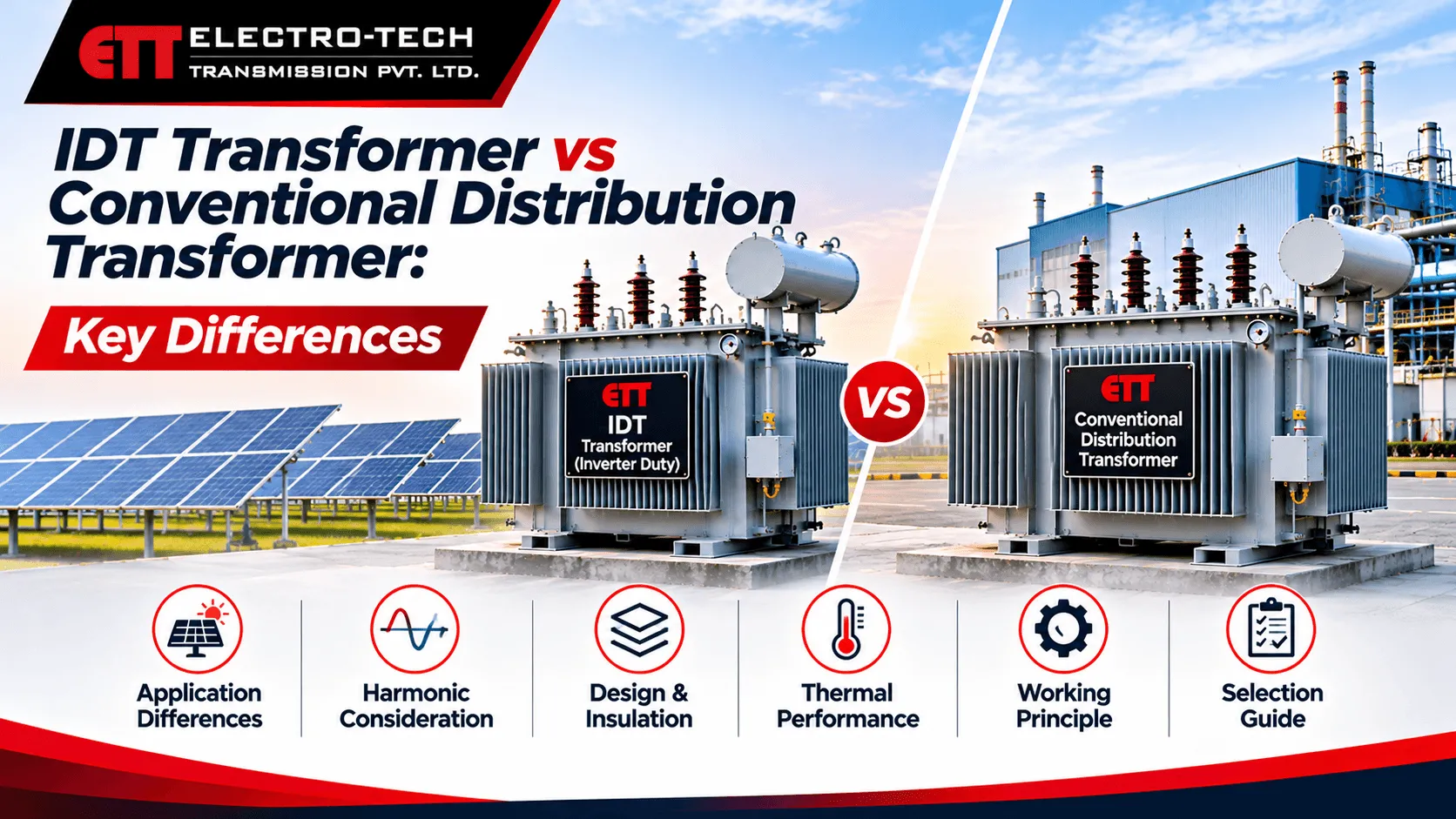
Transformers play an important role in industrial power distribution, renewable energy projects and electrical infrastructure. They help transfer electrical energy between different voltage levels and ensure that equipment receives power according to its operating requirements.
However, not all transformers are designed for the same applications.
An Inverter Duty Transformer (IDT) is designed to operate with inverter-based electrical systems, while a conventional distribution transformer is generally designed for standard electrical distribution requirements.
Although both work on the principle of electromagnetic induction, their design considerations can differ depending on the connected load, voltage waveform, harmonic content and operating conditions.
Understanding these differences is important for solar project developers, industrial facility owners, electrical contractors and procurement teams.
In this guide, we compare IDT transformers and conventional distribution transformers, explain their working principles, explore their applications and discuss how to select the right option for your project.
1. What Is an IDT Transformer?
IDT stands for Inverter Duty Transformer.
It is a specialised transformer designed to operate with inverter-based electrical systems and power electronic converters.
Inverter-based systems are commonly used in solar power plants, battery energy storage installations and selected industrial applications.
Unlike conventional electrical loads, inverters can introduce harmonic components and switching-related electrical stresses into the system.
These conditions can increase transformer losses, create additional heating and influence insulation requirements.
An IDT is therefore designed by considering the electrical characteristics of the connected inverter.
For example, in a solar power plant, photovoltaic panels generate DC electricity. The inverter converts this electricity into AC power, which is then supplied to an IDT.
The transformer steps up the voltage to the required level for the plant’s electrical collection network or grid connection.
The exact transformer configuration depends on the inverter specifications and project design.
2. What Is a Conventional Distribution Transformer?
A conventional distribution transformer is used to transfer electrical power from a distribution network to the voltage levels required by consumers and electrical equipment.
It is commonly found in:
- Industrial facilities.
- Commercial buildings.
- Residential distribution networks.
- Manufacturing units.
- Infrastructure projects.
- Electrical substations.
These transformers are designed according to specified voltage, frequency, loading and environmental conditions.
For example, an industrial facility may receive power at a medium-voltage level and use a distribution transformer to supply the lower voltage required by its machinery, lighting and auxiliary equipment.
The transformer capacity, voltage ratio, impedance and cooling arrangement are selected according to the electrical load and installation requirements.
Conventional distribution transformers are suitable for many standard power distribution applications. However, when connected to inverter-based equipment, additional electrical characteristics may need to be evaluated.
3. How Do IDT and Conventional Distribution Transformers Work?
Both transformer types operate using electromagnetic induction.
When alternating current flows through the primary winding, it produces a changing magnetic flux in the transformer core. This magnetic flux induces voltage in the secondary winding.
The voltage transformation depends on the relationship between the primary and secondary winding turns.
However, the electrical conditions under which the two transformer types operate can be different.
Working Principle of an IDT Transformer
In a typical solar installation, the process works as follows:
Step 1: DC Power Generation
Solar panels convert sunlight into DC electricity.
Step 2: DC-to-AC Conversion
The inverter converts the DC electricity into AC power.
Step 3: Voltage Transformation
The inverter output is supplied to the IDT, which transforms the voltage to the required level.
Step 4: Power Distribution
The transformed electrical power is transferred through the plant’s switchgear and electrical collection network.
The IDT must be designed according to the inverter’s output characteristics, including harmonic content and thermal requirements.
Working Principle of a Conventional Distribution Transformer
A conventional distribution transformer receives AC electrical power from an incoming distribution network.
It transforms the voltage according to the requirements of the connected electrical system.
For example, it may step down medium-voltage electricity to a lower voltage for industrial machinery, lighting and other equipment.
Its design is generally based on the expected load profile, voltage, frequency, insulation requirements and operating environment.
4. Key Differences Between IDT and Conventional Distribution Transformers
Although both transformers share the same fundamental operating principle, their application requirements and design considerations can differ.
Difference 1: Application
An IDT is primarily intended for inverter-based electrical systems.
Common applications include:
- Solar power plants.
- Selected wind energy systems.
- Battery energy storage systems.
- Industrial power electronic converter installations.
- Certain VFD-based applications.
A conventional distribution transformer is used for general electrical power distribution.
Common applications include:
- Industrial plants.
- Commercial buildings.
- Residential distribution systems.
- Manufacturing facilities.
- Infrastructure projects.
The intended application is one of the first factors to consider when selecting a transformer.
Difference 2: Harmonic Current Considerations
Harmonics are an important consideration when working with inverter-based electrical systems.
Power electronic converters use switching devices to convert electrical power. Depending on the design, they can introduce harmonic currents into the connected electrical network.
These harmonic currents may increase transformer losses and heating.
An IDT design therefore needs to consider the expected harmonic spectrum and its effect on winding losses, core losses and temperature rise.
Conventional distribution transformers are generally designed for their specified distribution load conditions.
However, they may also supply nonlinear loads such as VFDs, UPS systems and electronic equipment. In these cases, harmonic effects must also be evaluated.
The distinction is not that conventional transformers cannot handle any harmonics. It is that the transformer must be designed and rated for the actual harmonic conditions of its application.
Difference 3: Winding Design
Winding design influences current handling, electrical losses, insulation performance and thermal behaviour.
For an IDT, the winding design may require additional consideration of harmonic-related losses and the electrical characteristics of the connected inverter.
The design should account for the expected current waveform and operating conditions.
Conventional distribution transformer windings are generally designed around the specified voltage, current, frequency and loading requirements of the intended distribution application.
The final winding configuration depends on the project specifications and transformer design.
Difference 4: Insulation Requirements
Insulation is essential for preventing electrical breakdown and ensuring reliable transformer operation.
In inverter-based systems, switching characteristics and voltage waveforms may introduce additional electrical stress.
The IDT insulation system should therefore be suitable for the inverter output characteristics and specified operating conditions.
Conventional distribution transformers are designed according to their voltage class, insulation coordination requirements and applicable standards.
For both transformer types, insulation selection must be based on the actual electrical application rather than assumptions based only on transformer capacity.
Difference 5: Thermal Performance
Transformer losses generate heat during operation.
In inverter-based applications, harmonic currents can increase additional losses, potentially affecting transformer temperature.
An IDT must therefore be evaluated for its expected harmonic loading and thermal performance.
Conventional distribution transformers are designed around their specified loading conditions and cooling requirements.
For both types, ambient temperature, installation environment, loading profile and cooling arrangement influence thermal performance.
Difference 6: Operating Conditions
Solar power plants experience changing power generation depending on sunlight availability and environmental conditions.
Industrial inverter-fed systems may also operate under varying loads.
An IDT must be suitable for the operating characteristics of the connected power electronic system.
Conventional distribution transformers may serve facilities with continuous, intermittent or variable electrical loads.
Their specifications should reflect the actual load profile and expected operating conditions.
Difference 7: System Compatibility
IDT selection requires coordination with the inverter and the connected electrical network.
Important parameters include:
- Inverter output voltage.
- Rated AC capacity.
- Frequency.
- Power factor.
- Harmonic spectrum.
- Transformer impedance.
- Vector group.
- Earthing arrangement.
- Grid connection requirements.
Conventional distribution transformer selection also requires careful consideration of voltage, capacity, impedance, vector group, protection and installation conditions.
However, the inverter-specific characteristics become particularly important when specifying an IDT.
5. Where Are IDT Transformers Used?
IDT transformers are relevant wherever inverter-based systems require voltage transformation and electrical network integration.
Solar Power Plants
Solar power generation is one of the major applications.
Solar panels produce DC electricity, and inverters convert it into AC electricity.
The IDT transforms the inverter output to the voltage required by the plant’s collection network.
It is used in utility-scale solar projects, commercial solar installations and industrial solar power facilities.
Wind Energy Systems
Some wind turbine configurations use power electronic converters to manage electrical output.
Transformers in these systems must be selected according to the generator and converter characteristics.
The exact transformer requirements depend on the wind turbine electrical architecture.
Battery Energy Storage Systems
Battery energy storage systems use power conversion equipment to manage charging and discharging.
Transformers may be required to connect these systems to industrial networks or the electricity grid.
The selection must account for bidirectional power flow, converter specifications and operating cycles.
Industrial VFD Applications
Variable Frequency Drives are used to control the speed of industrial motors.
Applications include pumps, compressors, conveyors and manufacturing equipment.
Some VFD installations require application-specific transformers. However, not every VFD system requires a separate IDT.
The transformer requirement depends on the electrical arrangement and converter specifications.
6. Where Are Conventional Distribution Transformers Used?
Conventional distribution transformers are used in a wide range of electrical distribution applications.
Manufacturing Facilities
They supply electrical power to machinery, production lines, lighting and auxiliary systems.
Commercial Buildings
They support the distribution of electricity to HVAC systems, lifts, lighting and other building equipment.
Industrial Substations
They help transfer electricity between medium-voltage and lower-voltage distribution systems.
Infrastructure Projects
They are used in electrical installations supporting transportation facilities, public infrastructure and utility distribution networks.
Residential Distribution
They step down electricity to the voltage required by residential consumers.
The appropriate transformer type and rating depend on the load, voltage and installation requirements.
7. Can a Conventional Distribution Transformer Be Used for an Inverter-Based System?
This is an important question for solar project developers and industrial electrical engineers.
A conventional transformer may be suitable for certain inverter-based applications, but it should not be selected without a detailed technical evaluation.
The decision depends on:
- Inverter output characteristics.
- Harmonic current spectrum.
- Transformer loading.
- Winding and insulation design.
- Temperature-rise limits.
- Voltage and frequency.
- Impedance requirements.
- Protection coordination.
- Manufacturer recommendations.
If the transformer is not designed for the expected electrical conditions, additional heating and losses may affect its performance and service life.
The correct approach is to obtain the inverter manufacturer’s technical specifications and evaluate the transformer design against them.
A transformer should be selected based on engineering compatibility, not simply because its kVA rating appears suitable.
8. How to Select the Right Transformer for Your Project
Selecting between an IDT and a conventional distribution transformer begins with understanding the application.
Follow these steps before finalising your purchase.
Step 1: Identify the Electrical Application
Determine whether the transformer will serve a standard distribution network, solar inverter, VFD installation, battery energy storage system or another power electronic application.
Step 2: Calculate the Required Capacity
Identify the connected load, expected maximum demand and operating conditions.
For inverter-based applications, consider the total inverter AC capacity rather than relying only on the DC capacity of the solar panels.
Step 3: Confirm Voltage Requirements
Check the primary and secondary voltage levels, system frequency and required voltage ratio.
Step 4: Evaluate Harmonic Conditions
For inverter-based applications, obtain the expected harmonic spectrum and assess its effect on transformer losses and heating.
Step 5: Finalise the Vector Group and Impedance
The transformer vector group, impedance and earthing arrangement should be compatible with the electrical system and protection design.
Step 6: Review Cooling and Insulation
Select the appropriate cooling arrangement and insulation system based on the installation environment and expected operating conditions.
Step 7: Compare Efficiency and Losses
Evaluate guaranteed no-load and load losses rather than comparing transformers only by their initial purchase price.
Step 8: Verify Testing and Documentation
Review the technical data sheet, applicable standards, routine test reports and any required project-specific testing.
A qualified electrical engineer should approve the final transformer specification.
9. Why Choosing the Right Transformer Manufacturer Matters
Whether you need an IDT or a conventional distribution transformer, selecting the right manufacturing partner is important for long-term electrical system performance.
An experienced Transformer Manufacturer in India should be able to understand the project’s electrical requirements and provide relevant technical specifications.
Before choosing a manufacturer, evaluate:
- Manufacturing capabilities.
- Experience with the required transformer application.
- Winding and insulation design.
- Quality-control procedures.
- Testing facilities.
- Technical documentation.
- Compliance with applicable standards.
- Warranty and after-sales support.
Working with a dependable Transformer Supplier in India is also important for coordinating technical specifications, procurement requirements and delivery schedules.
For specialised applications, buyers should confirm that the manufacturer has the necessary design and testing capabilities for the intended transformer duty.
When evaluating the Top Transformer Manufacturer in India, focus on technical capabilities and relevant project experience rather than relying only on marketing claims.
Similarly, selecting the Top Transformer Supplier in India should involve checking product documentation, specification coordination and project support.
10. Final Checklist Before Purchasing an IDT or Conventional Transformer
Before placing an order, review the following requirements with your electrical engineering team:
- Intended transformer application.
- Required kVA or MVA capacity.
- Primary and secondary voltage.
- System frequency.
- Transformer vector group.
- Percentage impedance.
- Inverter specifications, where applicable.
- Harmonic current characteristics.
- Winding and insulation requirements.
- Cooling arrangement.
- No-load and load losses.
- Temperature-rise limits.
- Short-circuit withstand requirements.
- Protection and monitoring accessories.
- Applicable standards and testing requirements.
- Warranty and after-sales conditions.
A complete technical evaluation helps reduce specification mismatches and supports reliable transformer operation.
Frequently Asked Questions
1. What is the main difference between an IDT and a conventional distribution transformer?
An IDT is designed for inverter-based electrical applications and considers characteristics such as harmonic currents and switching-related electrical stresses. A conventional distribution transformer is generally designed for standard electrical distribution loads.
2. Is an IDT transformer used only in solar power plants?
No. IDT transformers can also be used in selected wind energy systems, battery energy storage installations and industrial power electronic applications. The exact requirement depends on the electrical system.
3. Can a conventional distribution transformer handle harmonic loads?
A conventional transformer may handle certain nonlinear loads if it is properly specified for the expected operating conditions. However, harmonic levels and their impact on losses and heating must be evaluated before selecting the transformer.
4. Why are harmonics important in IDT transformer design?
Harmonic currents can increase winding and other transformer losses, leading to additional heating. The transformer design must account for the expected harmonic spectrum and thermal requirements.
5. Are IDT transformers more expensive than conventional distribution transformers?
The cost depends on capacity, voltage, construction, insulation, cooling, harmonic requirements and project specifications. An IDT may involve additional application-specific design considerations, but a direct cost comparison requires quotations for equivalent technical requirements.
6. What information is needed to select an IDT transformer?
Important information includes inverter AC capacity, voltage, frequency, power factor, harmonic spectrum, transformer impedance, vector group, installation conditions and cooling requirements.
7. Which transformer should I choose for a solar power plant?
Solar power projects generally require a transformer designed to work with the selected inverter and electrical collection network. An IDT is commonly considered, but the final selection should follow the inverter manufacturer’s specifications and the project’s engineering requirements.
Conclusion
IDT transformers and conventional distribution transformers both perform voltage transformation through electromagnetic induction. However, their design requirements can differ depending on the connected electrical system.
An IDT is designed for inverter-based applications where harmonic currents, switching characteristics, insulation and thermal performance require specific consideration.
A conventional distribution transformer is generally used for standard electrical distribution applications across industrial, commercial and infrastructure facilities.
Choosing the right transformer requires an understanding of the electrical load, voltage requirements, operating conditions and connected equipment.
For solar developers, industrial facility owners and electrical contractors, working with an experienced transformer manufacturer and supplier can help ensure that the selected equipment matches the project’s technical requirements.
If you are planning a solar power installation, industrial project or transformer upgrade, contact ETT Groups to discuss your transformer requirements and explore suitable solutions.