
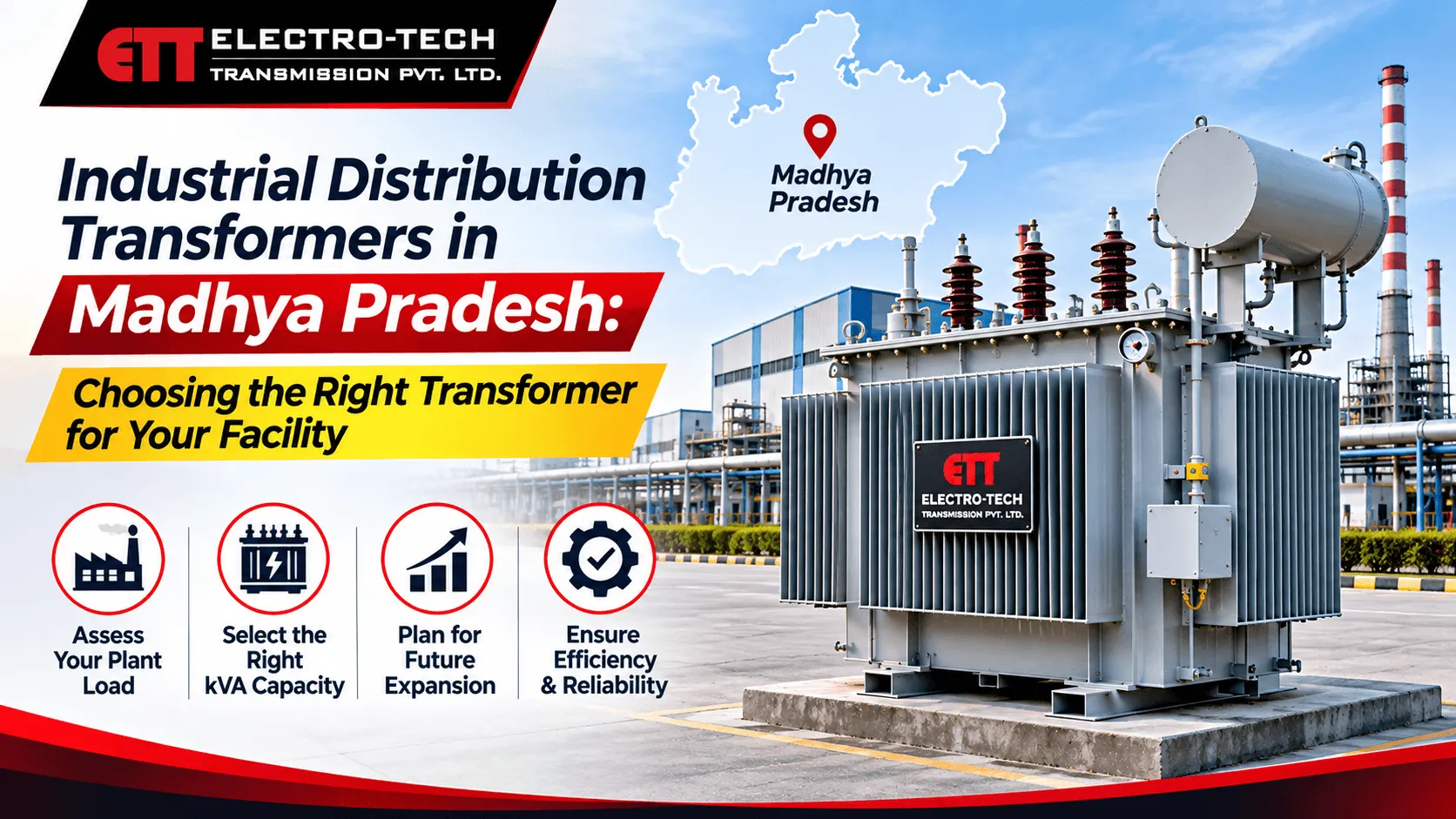
Industrial development depends on a reliable electrical infrastructure. From manufacturing units and engineering workshops to food processing facilities, warehouses and large industrial plants, businesses need a stable power supply to keep their operations running efficiently.
An important part of this infrastructure is the distribution transformer. It converts incoming electrical power into the voltage required by industrial equipment, machinery and internal distribution systems.
For businesses in Madhya Pradesh, selecting the right industrial distribution transformer requires careful consideration of electrical demand, operating conditions, installation requirements and future expansion plans.
Choosing an unsuitable transformer can lead to excessive loading, overheating, voltage fluctuations and unnecessary operating expenses. An oversized transformer can also increase initial investment and energy losses if it is not matched to the facility’s actual demand.
So, how should an industrial facility select the right transformer?
This guide explains the important factors businesses should evaluate before choosing a distribution transformer for their plant or industrial project in Madhya Pradesh.
1. Understand Your Facility’s Electrical Requirements
The first step in selecting a distribution transformer is understanding the electrical requirements of your facility.
Different industries have different power consumption patterns. A manufacturing plant operating heavy machinery may have different requirements from a warehouse, commercial facility or food processing unit.
Common industrial electrical loads include:
- Production machinery and manufacturing equipment.
- Motors, pumps and compressors.
- Industrial fans and ventilation systems.
- Welding and fabrication equipment.
- Heating and processing systems.
- Lighting and HVAC installations.
- Automation and control equipment.
- UPS systems and auxiliary equipment.
Start by preparing an electrical load schedule that identifies the connected equipment, rated power, voltage, power factor and expected operating hours.
However, simply adding the rated capacity of every machine is not enough. Not all equipment operates simultaneously or continuously.
The transformer must be selected based on the facility’s expected maximum demand and actual operating conditions.
2. Calculate the Required Transformer Capacity in kVA
Industrial distribution transformers are generally rated in kilovolt-amperes (kVA).
To determine the required capacity, engineers need to understand the relationship between real power, apparent power and power factor.
The basic formula is:
Required kVA = Load in kW ÷ Power Factor
For example, consider an industrial facility with an operating demand of 400 kW and a power factor of 0.90.
Required apparent power = 400 ÷ 0.90
Required apparent power = approximately 444 kVA.
This is only a preliminary calculation. The final transformer rating must also account for motor starting requirements, harmonics, loading conditions, future expansion and applicable engineering design margins.
Selecting a transformer based only on connected load or an approximate calculation can result in an unsuitable installation.
A qualified electrical engineer should evaluate the facility’s load profile before finalising the transformer capacity.
3. Consider the Industrial Load Profile
Industrial facilities rarely operate with a constant electrical load throughout the day.
Some plants operate continuously, while others experience significant variations depending on production schedules.
For example:
- Manufacturing machinery may operate during scheduled production shifts.
- Pumps and compressors may run intermittently.
- Welding equipment can create fluctuating electrical demand.
- Lighting and auxiliary systems may operate for extended periods.
- Some facilities may have seasonal variations in production.
Understanding these operating patterns helps engineers estimate the actual maximum demand.
For existing facilities, electricity meter readings and historical maximum-demand records can provide useful information.
For new industrial projects, the expected production schedule and equipment operating requirements should form the basis of the calculation.
This is particularly important when selecting a transformer for a new facility in Madhya Pradesh, where the electrical design should reflect the actual requirements of the proposed industrial operation.
4. Evaluate the Power Requirements of Heavy Machinery
Many industrial facilities use motors for compressors, pumps, conveyors and manufacturing equipment.
These motors may draw significantly higher current during starting than during normal operation.
This temporary increase is known as motor starting current or inrush current.
If a large motor starts while other machinery is operating, the electrical system may experience a temporary voltage drop.
This can affect:
- Motor starting performance.
- Sensitive electronic equipment.
- Production processes.
- Electrical protection systems.
- Overall power quality.
Before selecting a distribution transformer, identify the largest motors and understand their starting methods.
Common motor-starting methods include:
- Direct-on-line starting.
- Star-delta starting.
- Soft starters.
- Variable Frequency Drives (VFDs).
The transformer impedance, motor starting current and overall network design should be evaluated together.
A proper engineering assessment helps determine whether the proposed transformer can support the facility’s operating requirements.
5. Choose Between Oil-Immersed and Dry-Type Transformers
Transformer capacity is important, but the type of transformer also needs to match the installation environment.
Oil-immersed and dry-type transformers are two commonly considered options for industrial electrical installations.
Oil-Immersed Distribution Transformers
Oil-immersed transformers use insulating oil for electrical insulation and heat transfer.
They are commonly used in outdoor substations and industrial distribution applications.
Important considerations include:
- Cooling requirements.
- Installation location.
- Oil containment arrangements.
- Fire-safety requirements.
- Inspection and maintenance.
- Environmental protection.
They may be suitable for facilities where the installation design accommodates oil-filled electrical equipment.
Dry-Type Distribution Transformers
Dry-type transformers use air or solid insulation systems instead of insulating oil.
They may be considered for indoor installations or locations where oil handling and containment create additional challenges.
Important considerations include:
- Ventilation and cooling.
- Ambient temperature.
- Dust and moisture exposure.
- Enclosure protection.
- Available installation space.
- Maintenance accessibility.
Neither transformer type is universally suitable for every industrial facility. The decision should depend on the electrical design, installation environment, safety requirements and project specifications.
6. Consider Madhya Pradesh’s Industrial Operating Conditions
When selecting a transformer for a facility in Madhya Pradesh, businesses should evaluate the actual conditions at the proposed installation site.
The state has industrial and manufacturing activity across different locations, with facilities operating in sectors such as engineering, manufacturing, food processing and other industrial applications.
However, transformer requirements can vary significantly between facilities, even within the same industrial area.
Some important site-related factors include:
Ambient Temperature
High ambient temperatures can influence transformer cooling and thermal performance.
The transformer should be specified for the expected site conditions, including applicable temperature-rise requirements.
Dust and Environmental Exposure
Industrial environments may expose electrical equipment to dust, moisture and other contaminants.
The enclosure, insulation system and installation arrangement should be suitable for the location.
Indoor or Outdoor Installation
The installation location influences the required enclosure protection, ventilation, cooling and safety arrangements.
Outdoor substations may require different design considerations from indoor electrical rooms.
Power Supply Conditions
Businesses should evaluate incoming voltage conditions, supply reliability and electrical protection requirements.
The transformer specification should match the facility’s electrical distribution design.
Considering these factors before procurement can help avoid installation and operating problems later.
7. Plan for Future Industrial Expansion
A transformer should support the facility’s present electrical requirements while allowing for realistic future growth.
Industrial businesses may add production lines, machinery, compressors or other equipment as operations expand.
If the transformer has insufficient capacity for these additions, the business may need to upgrade its electrical infrastructure earlier than expected.
Before selecting a transformer, consider:
- Planned production expansion.
- Additional machinery and equipment.
- Changes in operating shifts.
- New utility systems.
- Expected increases in maximum demand.
- Future changes in manufacturing processes.
However, selecting a much larger transformer without a clear expansion plan is not always beneficial.
An oversized transformer can increase initial costs and may operate inefficiently if it remains lightly loaded for extended periods.
The objective is to balance present demand, realistic future requirements and transformer operating efficiency.
8. Evaluate Transformer Efficiency and Operating Losses
Distribution transformers operate for long periods, so their efficiency can influence the facility’s overall electricity expenses.
Two important types of transformer losses are:
No-load losses: These occur when the transformer is energised, even when it is not supplying a significant electrical load.
Load losses: These vary with the current flowing through the transformer and are influenced by winding resistance and other design characteristics.
When comparing transformer options, industrial buyers should evaluate:
- Guaranteed no-load losses.
- Guaranteed load losses.
- Efficiency at expected operating loads.
- Cooling arrangements.
- Temperature-rise limits.
- Expected operating hours.
- Maintenance requirements.
A transformer with a lower initial purchase price may not always be the most economical choice over its operating life.
Evaluating efficiency and losses helps businesses make a more informed investment decision.
9. Check Harmonic Distortion and Power Quality Requirements
Modern industrial facilities increasingly use electronic equipment and power converters.
These may include:
- Variable Frequency Drives.
- UPS systems.
- Rectifiers.
- Welding equipment.
- Industrial automation systems.
Such equipment can introduce harmonic currents into the electrical network.
Harmonic distortion may increase transformer heating and losses, depending on the level of distortion and the transformer design.
Facilities with significant nonlinear loads should conduct an appropriate harmonic assessment before finalising transformer specifications.
Power factor should also be evaluated because a lower power factor increases the apparent power required to supply a given amount of real power.
Where necessary, suitable power factor correction and harmonic mitigation arrangements should be considered as part of the overall electrical design.
10. Select a Reliable Transformer Manufacturer and Supplier
Selecting the right transformer is not only about calculating the required kVA rating. The manufacturer’s technical capabilities, product quality and ability to meet project specifications are also important.
Industrial businesses planning new installations or upgrades should work with an experienced Transformer Manufacturer in India that can understand their application requirements and provide suitable technical information.
Similarly, choosing a dependable Transformer Supplier in India can help businesses coordinate product specifications, procurement requirements and project-related support.
Before finalising a purchase, review the following:
- Transformer capacity and voltage ratings.
- Frequency and vector group.
- Impedance.
- Winding material.
- Cooling arrangement.
- Insulation requirements.
- Guaranteed losses.
- Temperature-rise limits.
- Applicable technical standards.
- Routine and type-test documentation.
- Warranty and after-sales conditions.
A detailed technical enquiry helps the manufacturer understand the facility’s requirements and prepare an appropriate proposal.
11. What to Check Before Finalising Your Transformer Purchase
When evaluating the Top Transformer Manufacturer in India, industrial buyers should look beyond product descriptions and marketing claims.
Review the manufacturer’s relevant experience, manufacturing capabilities, quality processes and ability to meet the required technical specifications.
It is also important to evaluate the Top Transformer Supplier in India based on its ability to coordinate the supply of the specified equipment and provide the necessary project support.
Before placing an order, request:
- Detailed technical specifications.
- Applicable compliance documents.
- Relevant test reports.
- Guaranteed loss values.
- Delivery and installation requirements.
- Warranty conditions.
- Technical support details.
- References for comparable applications, where available.
These checks help businesses make a better-informed procurement decision and reduce the possibility of specification-related misunderstandings.
12. Final Checklist for Industrial Facilities in Madhya Pradesh
Before selecting a distribution transformer for your facility, make sure the engineering team has reviewed the following:
- Total connected electrical load.
- Expected maximum demand.
- Operating power factor.
- Motor starting requirements.
- Harmonic distortion.
- Required transformer kVA rating.
- Primary and secondary voltage.
- Future expansion plans.
- Oil-immersed or dry-type construction.
- Installation environment and cooling requirements.
- Guaranteed no-load and load losses.
- Protection and earthing arrangements.
- Applicable standards and testing requirements.
- Warranty and after-sales support.
Transformer selection should be completed by qualified electrical engineers using actual load data, electrical drawings and relevant system studies.
Frequently Asked Questions
1. How do I choose the right transformer capacity for my industrial facility?
Start with a detailed electrical load schedule and calculate the expected maximum demand. Convert the real power demand into kVA using the operating power factor. Then evaluate motor starting, harmonics, future expansion and installation conditions before finalising the transformer rating.
2. Which transformer is suitable for manufacturing facilities in Madhya Pradesh?
The suitable transformer depends on the facility’s electrical demand, machinery, installation environment, cooling requirements and operating conditions. Both oil-immersed and dry-type transformers may be appropriate for different industrial applications.
3. Why is kVA important when selecting an industrial transformer?
Transformer capacity is generally expressed in kVA because the transformer must handle the combined voltage and current requirements of the connected electrical load. The required kVA depends on real power demand and power factor.
4. Should I choose a higher-capacity transformer for future expansion?
Future expansion should be considered during transformer selection, but the additional capacity should be based on realistic business and engineering plans. Excessive oversizing can increase initial costs and operating losses.
5. What is the difference between oil-immersed and dry-type transformers?
Oil-immersed transformers use insulating oil for cooling and insulation, while dry-type transformers use air or solid insulation systems. Their suitability depends on installation location, safety requirements, cooling and environmental conditions.
6. Why should industrial buyers evaluate transformer efficiency?
Transformer losses contribute to electricity consumption over the equipment’s operating life. Evaluating no-load and load losses helps businesses understand the long-term operating cost of different transformer options.
7. What information is required to request a transformer quotation?
Provide the required kVA rating, input and output voltage, frequency, load details, power factor, motor starting requirements, installation environment, cooling preference, applicable standards and any special technical requirements.
Conclusion
Selecting the right industrial distribution transformer is essential for maintaining reliable power distribution and supporting efficient facility operations.
For industrial businesses in Madhya Pradesh, the selection process should begin with an accurate assessment of electrical demand. Maximum loading, power factor, motor starting requirements, harmonics, installation conditions and future expansion all influence the final transformer specification.
Businesses should also evaluate transformer efficiency, construction type, technical documentation and long-term support before making a purchase decision.
Working with an experienced manufacturer and supplier can help simplify the selection process and ensure that the proposed transformer aligns with the facility’s electrical requirements.
If your business is planning a new industrial installation, transformer replacement or electrical capacity upgrade, connect with ETT Groups to discuss your transformer requirements and explore a suitable solution.