
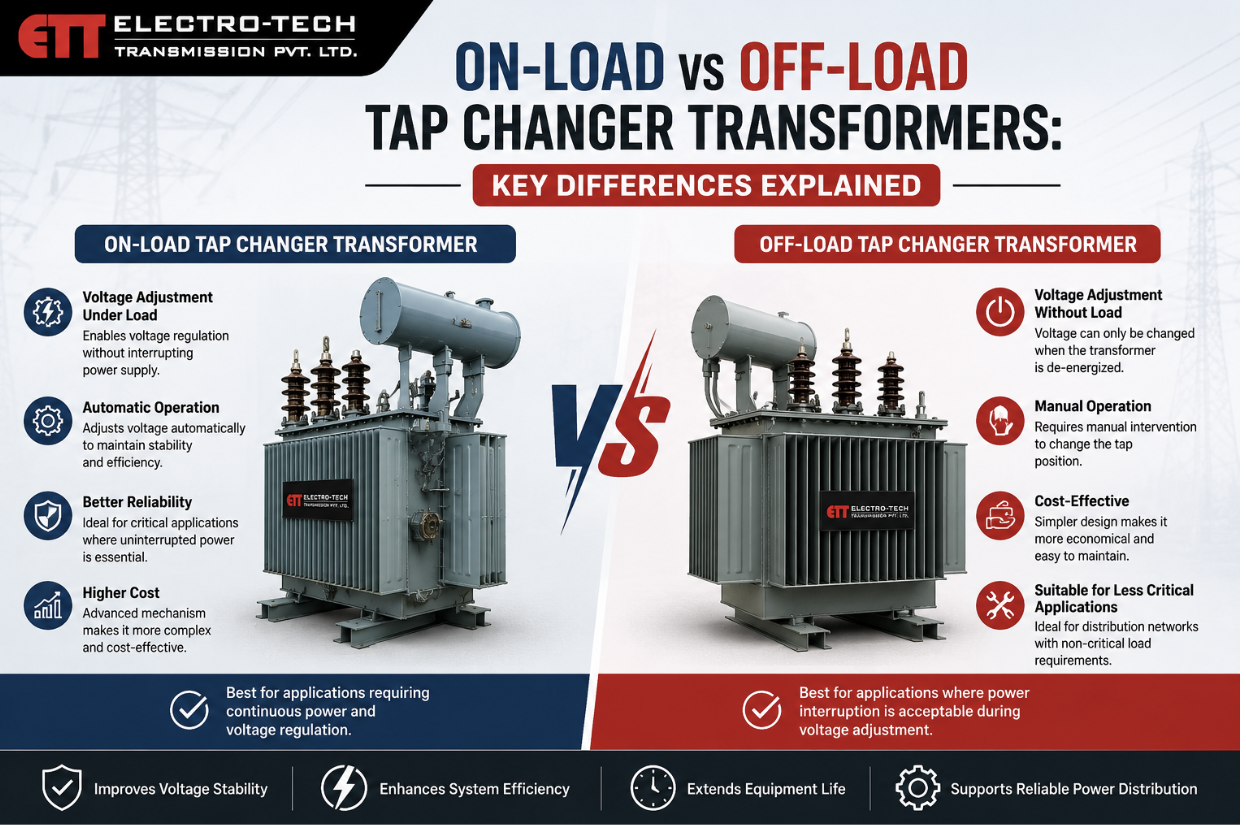
On-Load vs Off-Load Tap Changer Transformers: Key Differences Explained
Tap changers are an important part of transformer operation because they help regulate voltage and keep power delivery stable. The main difference between on-load and off-load tap changer transformers is whether the tap can be changed while the transformer is energized and carrying load. Understanding this difference helps industries choose the right transformer for performance, safety, and maintenance needs.
What a tap changer does
A tap changer adjusts the transformer’s voltage ratio by changing the number of turns in the winding. This helps maintain the desired output voltage when input conditions vary. In simple terms, it keeps voltage under control so equipment can run smoothly.
Voltage fluctuations can happen because of load changes, long cable runs, or supply variation. Tap changers help the transformer respond to those changes. That is why they are widely used in distribution and power transformers.
What is an on-load tap changer?
An on-load tap changer, often called OLTC, allows voltage adjustment while the transformer is operating and carrying load. This means the transformer does not need to be shut down before the tap position is changed. It is designed to handle live switching safely.
OLTC systems are commonly used where voltage regulation must be continuous and precise. They are especially useful in industries, substations, and heavy-duty power networks where interruptions are not acceptable.
What is an off-load tap changer?
An off-load tap changer, also called OLTC in some markets but more accurately off-circuit tap changer or no-load tap changer, can only be adjusted when the transformer is de-energized. The transformer must be switched off before changing the tap position. This makes the process simpler but less flexible.
Off-load tap changers are often used in systems where voltage changes are infrequent. They are suitable for applications where occasional manual adjustment is enough and continuous regulation is not necessary.
Key differences at a glance
- Operation during load: On-load tap changers work while the transformer is energized; off-load tap changers require shutdown.
- Voltage regulation: On-load tap changers provide continuous adjustment; off-load tap changers provide manual, occasional adjustment.
- Complexity: On-load systems are more complex mechanically and electrically; off-load systems are simpler.
- Cost: On-load tap changers are usually more expensive; off-load versions are more economical.
- Maintenance: On-load units generally need more maintenance because of moving contacts and switching mechanisms.
- Application: On-load tap changers suit industrial and utility systems; off-load tap changers suit simpler or less variable loads.
Advantages of on-load tap changers
On-load tap changers offer the biggest advantage in systems that need uninterrupted voltage control. Since the tap can be changed without switching off the transformer, they help avoid downtime. This is valuable in industries where even short interruptions can affect productivity.
They also improve voltage stability in networks with fluctuating demand. This helps protect sensitive equipment and supports better overall power quality.
Limitations of on-load tap changers
The main drawback of on-load tap changers is complexity. Because they operate while live, they require more sophisticated design, insulation, and switching arrangements. This makes them more expensive to buy and maintain.
They can also require periodic inspection and servicing. For some buyers, the extra cost is worth it, but for simpler applications, it may not be necessary.
Advantages of off-load tap changers
Off-load tap changers are simpler and more affordable. They are easier to design and maintain because they do not need to switch taps under load. This makes them a practical choice for systems where voltage does not change often.
They are often used in applications where manual adjustment during planned shutdowns is acceptable. For smaller or less demanding installations, they can be a cost-effective solution.
Limitations of off-load tap changers
The biggest limitation is that the transformer must be turned off before adjusting the tap. This means no live voltage correction is possible. If the supply fluctuates often, this can be inconvenient.
They are also less suitable for systems with dynamic load variation. In such cases, voltage may drift outside the ideal range between manual adjustments.
Which one is better for industries?
The better choice depends on how critical voltage stability is for your operation. If your facility uses sensitive equipment, runs continuously, or faces frequent load changes, an on-load tap changer may be the right option. It gives better control and avoids shutdowns.
If your application is simpler and voltage changes are rare, an off-load tap changer may be enough. It is lower cost and easier to maintain, which can be an advantage for budget-conscious buyers.
Factors to consider before choosing
Before selecting a transformer, industries should think about:
- Load variation.
- Sensitivity of equipment.
- Downtime tolerance.
- Maintenance capability.
- Budget.
- Long-term operating cost.
These factors will help determine whether the added complexity of an on-load tap changer is justified. For many industrial users, the decision comes down to balancing control and cost.
On-load and off-load tap changer transformers serve the same basic purpose, but they are designed for different operating needs. On-load tap changers give live voltage control and better stability, while off-load tap changers offer a simpler and more economical solution.
For industries, the right choice depends on how important voltage regulation, uptime, and maintenance are to the operation. Understanding the difference helps buyers make a smarter investment and choose the transformer that fits their system best.
FAQs
What is the main difference between on-load and off-load tap changers?
On-load tap changers can be adjusted while the transformer is operating, while off-load tap changers require the transformer to be switched off.
Why are on-load tap changers used in industries?
They provide continuous voltage regulation without interrupting power, which is useful for sensitive or high-demand operations.
Are off-load tap changers cheaper?
Yes, off-load tap changers are generally simpler and more economical.
Which tap changer needs more maintenance?
On-load tap changers usually need more maintenance because of their more complex switching mechanism.
Which one should I choose for my facility?
Choose on-load if voltage stability and uptime are critical. Choose off-load if your application is simpler and voltage adjustments are infrequent.