
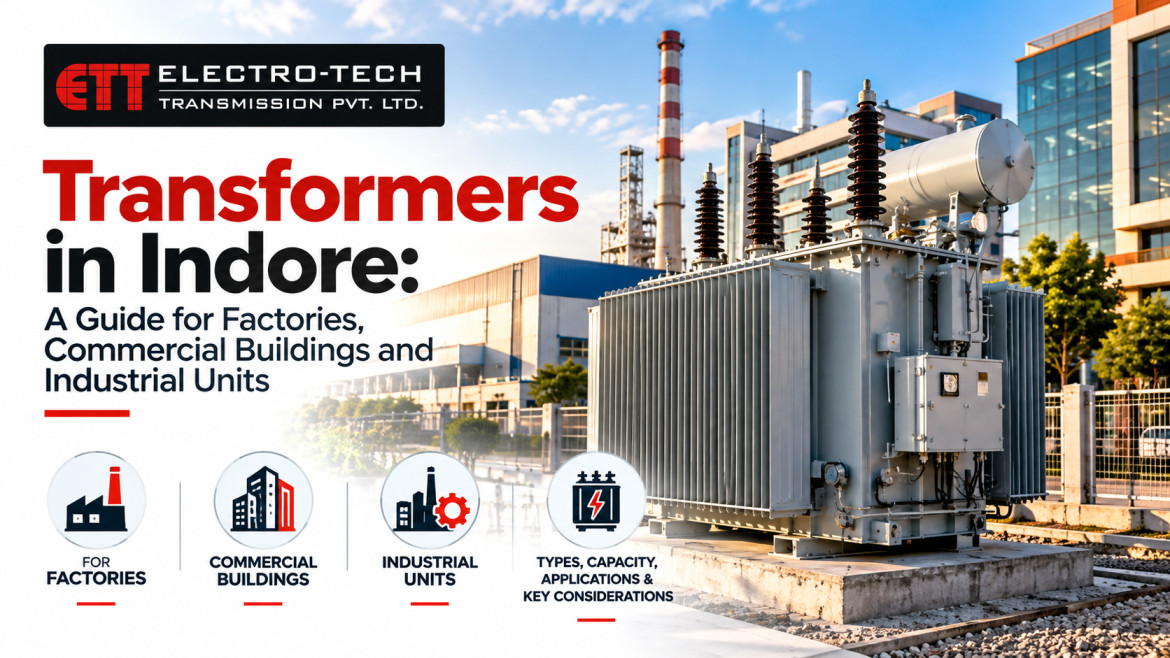
Reliable electricity is essential for manufacturing plants, commercial buildings, warehouses, and industrial facilities. As businesses expand and electrical loads increase, choosing the right transformer becomes an important part of planning a safe and dependable power distribution system.
A transformer helps transfer electrical energy between circuits and can increase or decrease voltage according to the requirements of the installation. Selecting the right unit depends on factors such as connected load, operating conditions, voltage requirements, energy efficiency, and future expansion plans.
For businesses searching for transformers in Indore, understanding these factors can help simplify the selection process and support reliable long-term operation.
1. Why Do Industries and Commercial Buildings Need Transformers?
Factories and commercial facilities often require electrical power at different voltage levels. A transformer helps adapt the incoming supply to the voltage required by the equipment and distribution network.
Common applications include:
- Manufacturing plants and industrial machinery.
- Commercial buildings, offices, and shopping complexes.
- Warehouses and logistics facilities.
- Industrial parks and infrastructure projects.
- Utilities and electrical distribution networks.
The appropriate transformer depends on the facility’s electrical design. A small commercial building may have very different requirements from a manufacturing plant operating heavy machinery throughout the day.
2. Types of Transformers Used in Industrial and Commercial Applications
Understanding the main transformer categories helps businesses identify suitable equipment for their projects.
Distribution Transformers
Distribution transformers reduce the voltage of an electrical supply to a level suitable for downstream distribution and use. They are commonly installed in industrial facilities, commercial complexes, and electrical distribution networks.
Businesses looking for a distribution transformer manufacturer in Indore should compare rated capacity, voltage ratio, cooling method, efficiency, protection requirements, and applicable standards.
Explore the ETT distribution transformer range to review available transformer models.
Power Transformers
Power transformers are used in applications involving higher power ratings and voltage levels, including substations and larger industrial power systems.
Their selection requires careful assessment of voltage levels, load requirements, operating conditions, and the electrical network design.
For larger projects, businesses can review the ETT power transformer range.
Industrial Distribution Transformers
Industrial distribution transformers support power distribution within manufacturing facilities and other industrial installations. They may supply production equipment, electrical panels, and other loads, depending on the installation design.
When evaluating industrial distribution transformers in Madhya Pradesh, businesses should consider both present demand and expected load growth. Correct sizing can help avoid unnecessary expenditure while ensuring that the transformer can meet the facility’s operational requirements.
3. How to Select the Right Transformer Capacity
Transformer capacity is generally expressed in kilovolt-amperes (kVA) or megavolt-amperes (MVA). Choosing the correct rating requires more than adding the wattage of connected equipment.
Consider the following factors:
- Connected load: Identify the equipment and electrical systems that will draw power.
- Maximum demand: Estimate the load likely to operate simultaneously.
- Power factor: Account for the relationship between real power and apparent power.
- Starting currents: Motors and other equipment may draw higher current during startup.
- Future expansion: Consider planned machinery additions or facility expansion.
- Operating conditions: Account for ambient temperature, installation location, and duty cycle.
For example, a factory with several motors may require a different transformer capacity from a commercial office with a similar total rated wattage. Starting currents, load patterns, and power factor can influence the final selection.
A qualified electrical engineer should calculate the required capacity and verify the design before procurement.
4. Why Energy Efficiency Matters
Transformers consume energy through no-load losses and load-related losses. No-load losses occur whenever the transformer is energised, while load losses generally increase as the electrical load increases.
Over time, these losses contribute to operating costs. This makes efficiency an important consideration when comparing transformer models.
Businesses evaluating energy-efficient transformers in Indore should review:
- Guaranteed no-load and load losses.
- Applicable efficiency requirements and standards.
- Expected operating hours.
- Typical loading throughout the day.
- Purchase price compared with projected operating costs.
A transformer with lower losses may offer long-term savings, especially in facilities that operate continuously. However, the best option depends on actual loading, energy costs, and the specifications of the equipment.
5. Key Factors When Choosing a Transformer Supplier
Selecting a transformer supplier involves more than comparing quotations. The equipment must meet the project’s technical requirements and be supported by appropriate documentation and service.
Before choosing a supplier, check the following.
Technical specifications: Confirm rated capacity, primary and secondary voltages, frequency, phase configuration, cooling type, and required accessories.
Applicable standards: Verify compliance with relevant Indian Standards and project-specific requirements.
Testing and documentation: Ask for applicable test reports, drawings, technical datasheets, and warranty documentation.
Installation and support: Confirm whether installation guidance, commissioning support, inspection, or maintenance services are available.
Delivery schedule: Ensure the proposed manufacturing and delivery timeline meets the project plan.
Businesses comparing transformer suppliers in India should evaluate these factors alongside price to make an informed purchasing decision.
6. Finding Transformers in Indore and Madhya Pradesh
Indore is an important commercial and industrial centre in Madhya Pradesh. Businesses undertaking new installations or expanding existing facilities may need transformers suited to manufacturing, commercial power distribution, or infrastructure projects.
When evaluating the best transformers in Madhya Pradesh, start by identifying the electrical requirements of your site. Then shortlist manufacturers based on product suitability, technical documentation, applicable standards, and after-sales support.
Electro-Tech Transmission (ETT) lists distribution transformers and power transformers in its product portfolio. Businesses can review its transformer product range and contact the company to discuss project-specific requirements.
Before finalising a purchase, confirm the current specifications, availability, warranty, and delivery terms directly with the supplier.
7. Installation and Maintenance Considerations
Correct installation and regular inspection help support transformer reliability and service life.
Important considerations include:
- Installing the transformer according to the approved electrical design.
- Providing appropriate ventilation and clearances.
- Ensuring suitable earthing and electrical protection.
- Inspecting connections, bushings, and other accessible components.
- Monitoring operating temperature and loading.
- Following the manufacturer’s inspection and maintenance schedule.
Oil-filled transformers may require additional checks relating to oil condition, leakage, and associated protection systems. Dry-type transformers have different inspection and maintenance requirements.
All installation, testing, and maintenance activities should be performed by qualified personnel in accordance with the manufacturer’s instructions and applicable safety standards.
Frequently Asked Questions
1. Which transformer is suitable for a factory?
The appropriate transformer depends on the factory’s load, voltage requirements, motor starting characteristics, operating schedule, and future expansion plans. A qualified electrical engineer should determine the required capacity and specifications.
2. What is a distribution transformer used for?
A distribution transformer reduces voltage to a level suitable for downstream electrical distribution. It is commonly used in commercial buildings, industrial facilities, and utility networks.
3. How do I choose an energy-efficient transformer?
Compare guaranteed no-load and load losses, applicable efficiency requirements, operating hours, and expected loading. Evaluating lifetime operating costs can provide a more useful comparison than purchase price alone.
4. What should I check before buying a transformer in Indore?
Review the required capacity, voltage ratio, phase configuration, cooling method, applicable standards, test documentation, warranty, delivery schedule, and available technical support.
5. Where can I find transformer manufacturers and suppliers in India?
Start by reviewing manufacturers’ product ranges and technical information. For industrial or commercial requirements, contact the shortlisted suppliers with your load details and electrical specifications to obtain suitable recommendations and quotations.
Conclusion
Choosing the right transformer is an important decision for factories, commercial buildings, and industrial units. Capacity, voltage requirements, efficiency, installation conditions, and technical support all influence the suitability of a transformer for a particular project.
Businesses evaluating transformers in Indore should establish their electrical requirements first and then compare products based on specifications, applicable standards, and long-term operating costs.
Explore the ETT transformer product range to review available options and discuss your project’s requirements with the supplier.