
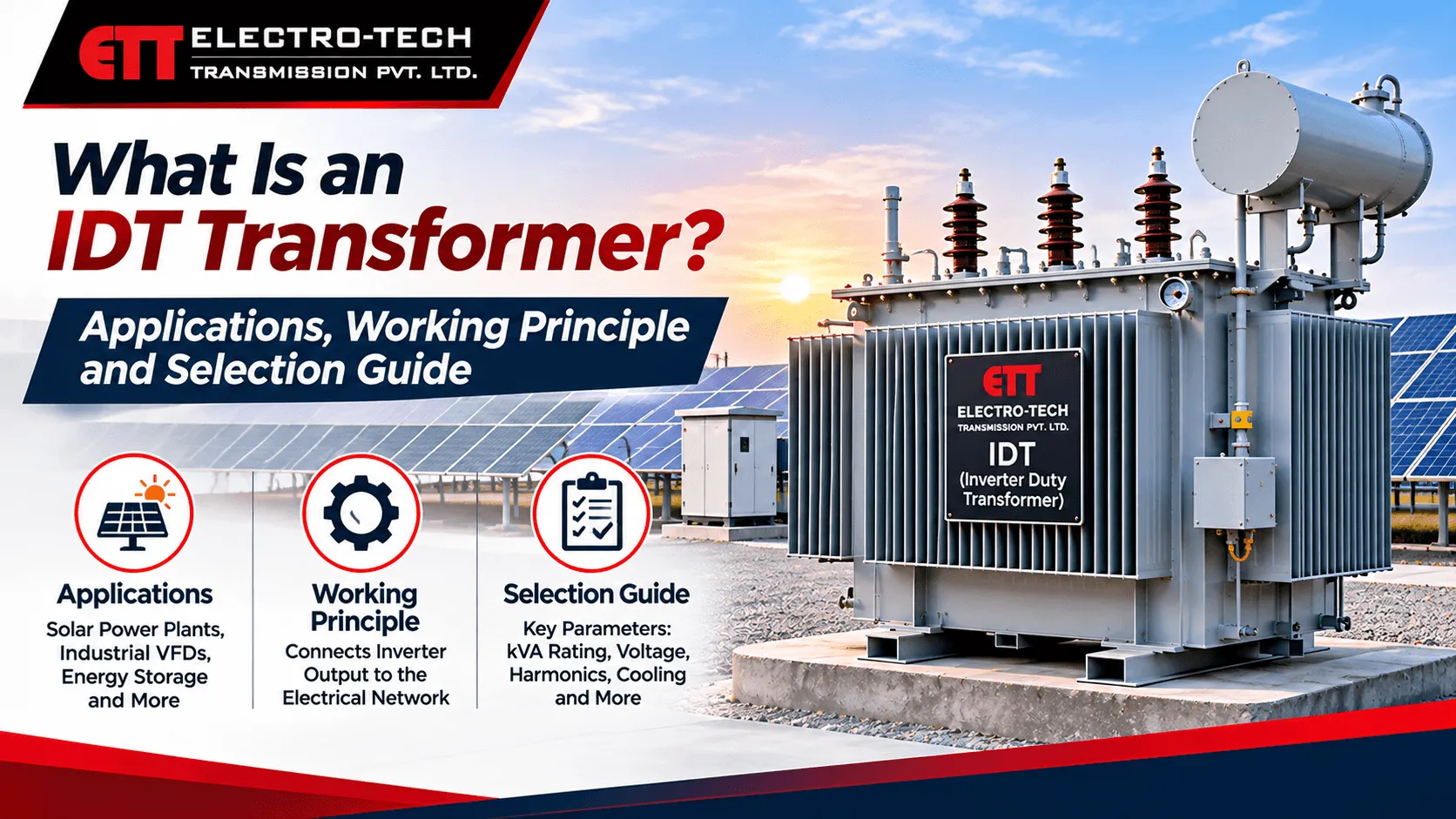
Modern industrial facilities and renewable energy projects increasingly depend on power electronic equipment such as solar inverters, variable frequency drives (VFDs) and other electronic converters.
These systems help control electrical power, improve operational flexibility and support efficient energy generation. However, they also introduce electrical conditions that conventional transformers may not be designed to handle.
This is where an Inverter Duty Transformer (IDT) becomes important.
An IDT transformer is specially designed to operate with inverter-based electrical systems. It helps transfer electrical power between the inverter and the connected distribution network while accounting for factors such as harmonic currents, electrical losses, temperature rise and insulation requirements.
IDT transformers are widely relevant to solar power plants and can also be used in selected industrial applications involving inverter-fed equipment.
Understanding how these transformers work, where they are used and what to consider during selection can help project developers, electrical engineers and industrial buyers make better procurement decisions.
1. What Is an IDT Transformer?
IDT stands for Inverter Duty Transformer.
It is a specialised power transformer designed to work with electrical systems that use inverters or power electronic converters.
Unlike conventional electrical loads that generally operate with sinusoidal current, inverter-based systems can produce non-sinusoidal waveforms containing harmonic components and switching-related electrical stresses.
These conditions can increase transformer losses, create additional heating and place greater demands on the insulation system.
An IDT is therefore designed with the characteristics of the connected inverter system in mind.
In a solar power plant, for example, solar panels generate DC electricity. The inverter converts this electricity into AC power, which is then supplied through a transformer to the plant’s medium-voltage electrical network.
The IDT performs the required voltage transformation and helps connect the inverter output to the electrical distribution system.
Depending on the project configuration, it may be used as a step-up transformer between the inverter’s low-voltage AC output and the medium-voltage collection network.
The exact design depends on the inverter specifications, project voltage levels, power rating and grid connection requirements.
2. Why Are IDT Transformers Required?
A conventional transformer is generally designed around specified voltage, frequency and load conditions.
However, inverter-based systems can introduce additional electrical stresses.
Some important considerations include:
Harmonic currents: Power electronic converters can produce harmonic components that increase additional losses and heating in transformer windings and other components.
Voltage switching: Inverters use electronic switching to convert DC power into AC power. Depending on the inverter design, the resulting voltage waveform can introduce additional insulation stress.
Variable loading: Solar power generation changes with sunlight availability. Industrial inverter-fed applications may also experience varying load conditions.
Thermal performance: Additional losses caused by harmonic currents can influence transformer temperature and cooling requirements.
Insulation requirements: The transformer insulation system must be appropriate for the voltage waveform, switching conditions and electrical environment.
These factors make application-specific transformer design important.
Using a standard transformer without evaluating the inverter’s electrical characteristics may result in unsuitable thermal performance, excessive losses or premature ageing.
The correct approach is to review the inverter data and transformer requirements together before finalising the design.
3. Working Principle of an IDT Transformer
The working principle of an IDT is based on electromagnetic induction, the same fundamental principle used in conventional transformers.
A transformer transfers electrical energy between windings through a changing magnetic field.
However, an IDT is designed to operate under the electrical conditions associated with inverter-based equipment.
Here is how it works in a typical solar power installation.
Step 1: Solar Panels Generate DC Electricity
Solar photovoltaic modules convert sunlight into direct current (DC) electricity.
Multiple modules are connected to form strings and arrays to achieve the required power output.
Step 2: The Inverter Converts DC into AC
The inverter converts the DC electricity generated by the solar panels into alternating current (AC).
The output voltage and frequency are controlled according to the inverter’s operating requirements and the electrical system.
However, inverter switching can introduce harmonic components and other waveform characteristics that must be considered during transformer selection.
Step 3: The IDT Transforms the Voltage
The inverter output is connected to the IDT.
The transformer changes the voltage from the inverter-side level to the required voltage of the plant’s electrical collection network.
For example, a solar installation may use an inverter output at a lower AC voltage and step it up to a medium-voltage collection level such as 11 kV or 33 kV, depending on the project design.
Step 4: Power Is Transferred to the Electrical Network
The transformed power is supplied to the plant’s medium-voltage system and subsequently transferred through the appropriate switchgear, protection and grid-interconnection equipment.
The complete arrangement depends on the solar plant’s electrical architecture and grid connection requirements.
Typical solar power flow:
Solar Panels → DC Collection System → Inverter → IDT Transformer → Medium-Voltage Switchgear → Grid Connection
The IDT is therefore an important component connecting power electronic equipment with the electrical distribution network.
4. Major Applications of IDT Transformers
IDT transformers are used in applications where inverter-based equipment forms an important part of the electrical system.
Some major applications include:
Solar Power Plants
Solar power generation is one of the most important applications of inverter duty transformers.
Solar inverters convert the DC output of photovoltaic modules into AC electricity. The IDT then transforms the voltage to match the plant’s medium-voltage collection system.
They are used in:
- Utility-scale solar power plants.
- Ground-mounted solar installations.
- Large commercial solar projects.
- Industrial solar power facilities.
- Grid-connected renewable energy projects.
The transformer specification depends on the inverter output, total connected capacity and grid connection requirements.
Wind Energy Systems
Wind turbines use power electronic converters in certain configurations to manage the generated electrical power.
Transformers used in these systems must be selected according to the generator, converter and electrical network characteristics.
The suitability of an inverter duty transformer depends on the specific wind turbine electrical architecture.
Industrial Variable Frequency Drives
Industrial facilities use VFDs to control motor speed and torque.
Applications include:
- Water pumping systems.
- Industrial compressors.
- Conveyor systems.
- Manufacturing machinery.
- Fans and ventilation systems.
- Process control equipment.
Where the electrical arrangement requires a transformer on the converter side, the design should account for the VFD output characteristics, harmonic conditions and motor requirements.
Not every VFD installation requires a separate IDT. The transformer requirement depends on the system architecture.
Battery Energy Storage Systems
Battery energy storage installations use power conversion systems to manage charging and discharging.
Transformers may be required to connect these systems to the facility’s electrical network or grid.
Their specifications should consider the converter output, bidirectional power flow, operating cycles and project requirements.
5. Important Components of an IDT Transformer
An IDT consists of several important electrical and mechanical components.
Magnetic Core
The magnetic core provides the path for magnetic flux between the transformer windings.
Its design and material influence no-load losses, magnetic performance and overall efficiency.
Primary and Secondary Windings
The windings transfer electrical energy through electromagnetic induction.
Their voltage ratings, current capacity, insulation and configuration are determined by the application.
IDT winding design must account for the expected current waveform and harmonic-related losses.
Insulation System
The insulation system separates electrical conductors and protects the transformer against electrical stress.
Its selection depends on voltage class, operating conditions, switching characteristics and applicable insulation requirements.
Cooling System
Transformer losses generate heat during operation.
A suitable cooling arrangement helps maintain the required operating temperature.
Common cooling arrangements for oil-immersed transformers include ONAN and ONAF, depending on the design and rating.
The appropriate cooling method depends on transformer capacity, installation conditions and thermal requirements.
Transformer Tank and Accessories
Oil-immersed IDTs generally include a tank and accessories required for operation, monitoring and protection.
Depending on the design, these may include:
- Oil temperature indicators.
- Winding temperature indicators.
- Pressure relief devices.
- Oil level indicators.
- Buchholz relay, where applicable.
- Conservator.
- Breather.
- Drain and filter valves.
The required accessories should be established according to the transformer design and project specifications.
6. IDT Transformer vs Conventional Distribution Transformer
Although both transformers operate using electromagnetic induction, their design requirements can differ significantly.
A conventional distribution transformer is generally designed for standard electrical distribution loads.
An inverter duty transformer is designed around the electrical characteristics of inverter-based equipment.
Some important differences include:
Load characteristics: Conventional transformers are generally specified for their intended distribution load profile. IDTs must account for the harmonic content and operating characteristics of connected inverters.
Winding design: IDT winding design may require additional consideration of harmonic-related losses and thermal performance.
Insulation: The insulation system must be suitable for the voltage waveform and switching stresses associated with the application.
Thermal design: Harmonic currents can increase losses and heating, so thermal calculations should reflect the actual electrical conditions.
Application: Conventional distribution transformers serve general power distribution requirements, while IDTs are used in inverter-based systems such as solar installations and selected industrial applications.
A conventional transformer should not automatically be treated as a suitable replacement for an IDT. The inverter manufacturer’s requirements and the project’s electrical design should determine the correct transformer specification.
7. Important Technical Specifications to Consider When Selecting an IDT
Selecting an IDT requires more than choosing a transformer based on its MVA or kVA rating.
The electrical and operating characteristics of the connected inverter system must be evaluated.
Transformer Capacity
The transformer capacity should match the expected inverter output and operating requirements.
For a solar project, engineers should consider the total connected inverter AC capacity, expected loading, power factor and applicable design conditions.
The rating should not be selected using the solar panel DC capacity alone.
Primary and Secondary Voltage
The transformer voltage ratings must match the inverter output and the electrical network.
The voltage configuration depends on the project design.
For example, a solar inverter may operate at a low AC voltage, while the plant collection network may use a medium-voltage level.
Frequency
The transformer should be designed for the specified system frequency.
For most Indian grid-connected applications, the system frequency is 50 Hz.
Impedance
Transformer impedance influences voltage regulation and short-circuit current.
It also affects protection coordination and system performance.
The appropriate impedance should be selected based on the project fault-level study and electrical design.
Vector Group
The transformer vector group determines the winding connections and phase displacement between primary and secondary windings.
It also influences grounding arrangements and harmonic behaviour.
Common vector groups may include Dyn11 and YNd11, depending on the application.
The correct vector group should be finalised based on inverter requirements, system earthing, protection coordination and grid connection specifications.
Harmonic Performance
Harmonic current content should be evaluated using the inverter manufacturer’s technical information.
The transformer design should consider the expected harmonic spectrum and its impact on additional losses and temperature rise.
A generic harmonic rating should not be assumed without reviewing the actual application.
Cooling and Temperature Rise
Cooling arrangements and temperature-rise limits must be suitable for the expected operating conditions.
Ambient temperature, installation altitude, enclosure arrangements and loading profile should be considered.
Efficiency and Losses
No-load losses and load losses influence transformer operating efficiency.
These values should be reviewed when comparing different transformer designs.
8. How to Select the Right IDT Transformer for Your Project
A structured selection process helps avoid specification mismatches and unnecessary procurement costs.
Follow these important steps:
Step 1: Identify the application
Determine whether the transformer will be used in a solar power plant, industrial VFD installation, battery energy storage system or another inverter-based application.
Step 2: Collect inverter specifications
Obtain the inverter’s rated AC output, voltage, current, power factor range, harmonic information and operating characteristics.
Step 3: Calculate the required transformer capacity
Evaluate the total connected inverter AC capacity and the expected operating conditions.
Consider ambient temperature, altitude, loading profile and any project-specific design margins.
Step 4: Finalise voltage and vector group
Determine the primary and secondary voltage levels, winding connections, grounding arrangement and phase displacement.
Step 5: Evaluate harmonic and thermal requirements
Review the expected harmonic spectrum and calculate the associated losses and temperature rise.
Step 6: Select the cooling arrangement
Choose the appropriate cooling method based on transformer rating, installation conditions and project requirements.
Step 7: Review protection and testing requirements
Confirm impedance, short-circuit withstand requirements, protection coordination, accessories and applicable factory testing.
Step 8: Finalise the technical specification
Prepare a detailed transformer data sheet covering all electrical, mechanical, thermal and performance requirements before requesting quotations.
This process helps ensure that the selected transformer is suitable for the complete inverter-based electrical system.
9. Why Choosing an Experienced IDT Transformer Manufacturer Matters
IDT transformers are application-specific electrical equipment. Their design requires an understanding of transformer engineering as well as the characteristics of the connected inverter system.
For renewable energy developers and industrial buyers, selecting an experienced Transformer Manufacturer in India is an important part of the procurement process.
A suitable manufacturing partner should be able to review the project specifications and provide relevant technical documentation.
When evaluating an IDT manufacturer, consider:
- Experience with inverter-based applications.
- Manufacturing and quality-control capabilities.
- Ability to meet specified voltage and capacity requirements.
- Winding and insulation design capabilities.
- Harmonic and thermal design considerations.
- Testing and inspection facilities.
- Technical documentation.
- Warranty and after-sales support.
It is equally important to work with a reliable Transformer Supplier in India that can coordinate the required specifications, delivery requirements and project documentation.
Before finalising a purchase, buyers should request the approved technical data sheet, guaranteed performance values and relevant test reports.
10. What to Check Before Purchasing an IDT Transformer
Before selecting a manufacturer or finalising a transformer order, review the following information:
- Transformer capacity and voltage ratings.
- Inverter technical specifications.
- Frequency and vector group.
- Percentage impedance.
- Harmonic current characteristics.
- Winding material and configuration.
- Insulation system.
- Cooling arrangement.
- No-load and load losses.
- Temperature-rise limits.
- Short-circuit withstand requirements.
- Protection accessories.
- Applicable standards.
- Routine and type-test documentation.
- Warranty and service conditions.
When comparing the Top Transformer Manufacturer in India, evaluate technical capabilities and relevant manufacturing experience rather than relying only on marketing claims.
Similarly, selecting the Top Transformer Supplier in India should involve reviewing product specifications, documentation, delivery coordination and project support.
The final transformer specification should always be approved by the project’s electrical engineering team.
Frequently Asked Questions
1. What does IDT stand for in electrical engineering?
IDT stands for Inverter Duty Transformer. It is a specialised transformer designed for electrical systems involving inverters and power electronic converters.
2. What is the main purpose of an IDT transformer?
Its main purpose is to transfer electrical power between an inverter-based system and the connected electrical network while meeting the application’s voltage, harmonic, thermal and insulation requirements.
3. Why are IDT transformers used in solar power plants?
Solar inverters convert DC electricity from photovoltaic modules into AC electricity. An IDT transforms the inverter output voltage to the level required by the solar plant’s medium-voltage collection network or connected electrical system.
4. Can a conventional distribution transformer be used instead of an IDT?
Not automatically. A conventional transformer may not be designed for the harmonic content and switching-related electrical conditions of a particular inverter system. The inverter manufacturer’s requirements and project engineering study should determine whether a conventional transformer is suitable.
5. What is the difference between an IDT and a power transformer?
An IDT describes a transformer designed for inverter-based electrical applications. A power transformer is generally classified by its role and application in power transmission or large-scale voltage transformation. Their ratings and design requirements can overlap, so the actual project specifications matter more than the name alone.
6. What information is needed to select an IDT transformer?
Important information includes inverter AC capacity, input and output voltage, frequency, harmonic characteristics, power factor, impedance requirements, vector group, installation environment, cooling requirements and applicable grid specifications.
7. Are IDT transformers used only in solar power plants?
No. They are also relevant to selected wind energy systems, industrial converter-fed applications, VFD installations and battery energy storage systems. The exact transformer design depends on the electrical configuration.
Conclusion
Inverter Duty Transformers play an important role in modern electrical infrastructure, particularly in solar power plants and industrial systems that depend on power electronic converters.
Their design must account for more than voltage transformation. Harmonic currents, switching characteristics, insulation requirements, thermal performance and operating conditions all influence the final specification.
Selecting the right IDT requires a detailed understanding of the connected inverter system and the electrical network.
For renewable energy developers, industrial project owners and electrical contractors, working with an experienced transformer manufacturer and supplier can help simplify the technical evaluation and procurement process.
If you are planning a solar power project or an industrial installation involving inverter-based equipment, contact ETT Groups to discuss your transformer requirements and explore suitable solutions.