
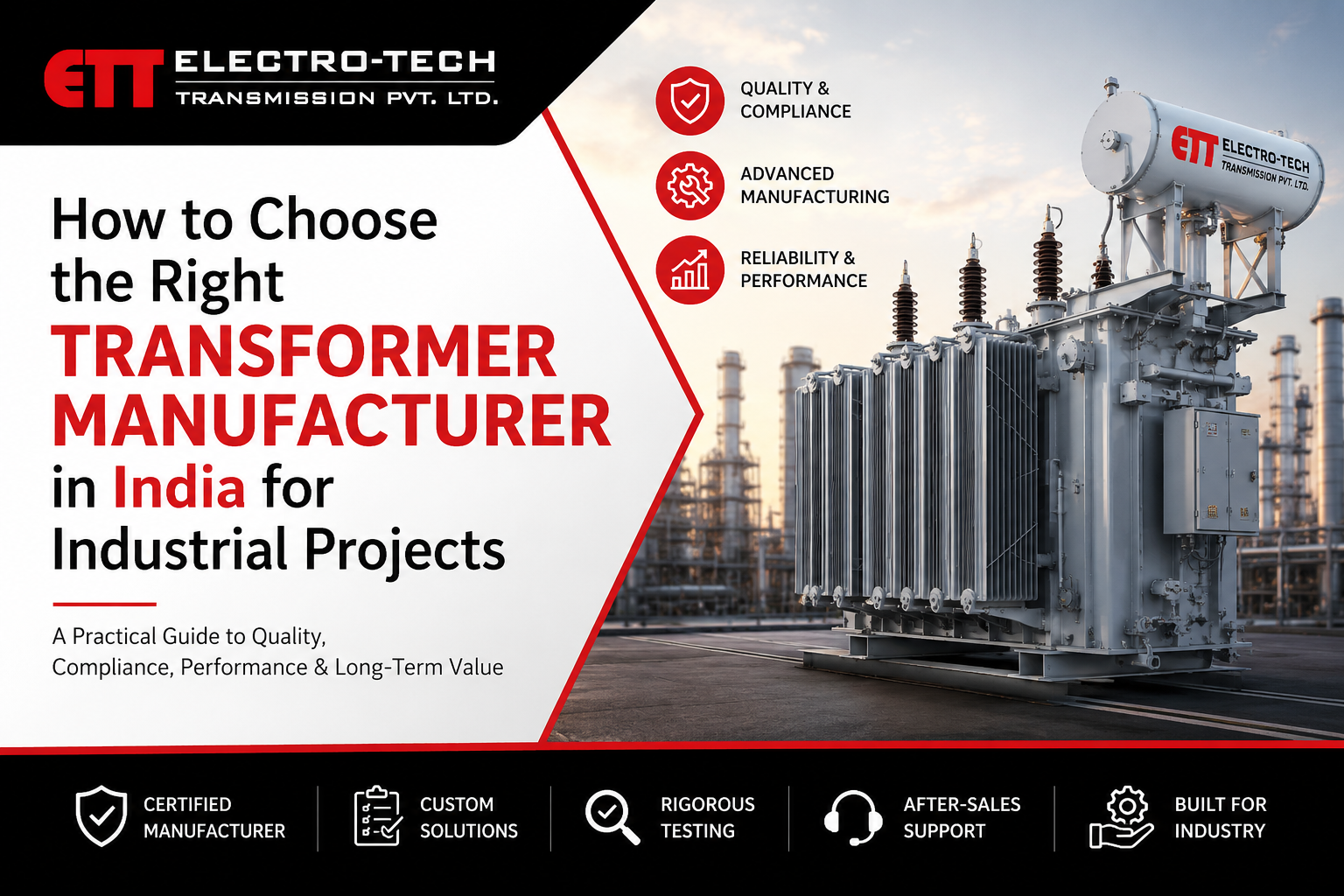
Choosing the right Transformer Manufacturer in India requires more than comparing quotations. Industrial buyers should evaluate applicable standards, manufacturing capability, testing infrastructure, transformer efficiency, technical design, customization ability, project experience, delivery timelines, warranty terms, and after-sales support before issuing a purchase order.
The transformer must also be selected for the actual application. Load profile, voltage levels, installation environment, future expansion, cooling requirements, impedance, tapping arrangement, and operating conditions can all influence the correct design.
For procurement teams, EPC contractors, consultants, and plant engineers, the best decision is therefore not necessarily the manufacturer offering the lowest initial price. It is the supplier capable of delivering a technically appropriate transformer with documented quality, predictable performance, suitable testing, and reliable lifecycle support.
How Do I Choose a Transformer Manufacturer in India?
Choose a transformer manufacturer by evaluating nine factors: applicable standards and certification, manufacturing capability, testing facilities, technical-design expertise, energy efficiency, customization capability, relevant project experience, delivery reliability, and after-sales support. Always compare manufacturers against the same technical specification rather than comparing price alone.
A practical evaluation should cover:
- Applicable BIS/Indian Standards compliance
- Manufacturing and quality-control infrastructure
- In-house and third-party testing capabilities
- Ability to design for your actual load and site conditions
- No-load and load-loss performance
- Experience with similar industrial applications
- Custom engineering capabilities
- Delivery, warranty, commissioning, and service support
- Total lifecycle cost rather than only purchase price
This approach is particularly important for industrial applications, where transformer failure or poor specification can affect production, equipment reliability, and operating costs.
What Certifications and Indian Standards Should a Transformer Manufacturer Comply With?
The applicable standard depends on the transformer category. IS 2026 is the principal Indian Standards series covering power transformers, while IS 1180 addresses specified categories of distribution transformers. Buyers should identify the exact standard applicable to their transformer and verify any required BIS licence rather than accepting a general claim of “BIS compliant.”
The Bureau of Indian Standards identifies IS 2026 (Part 1):2011 as the general standard for power transformers, covering areas including service conditions, ratings, and testing. The broader IS 2026 series contains additional parts dealing with matters such as temperature rise, insulation and dielectric testing, short-circuit withstand capability, loading, dry-type transformers, and certain specialized applications.
For distribution transformers, BIS identifies the IS 1180 series. IS 1180 (Part 1):2014 covers outdoor mineral-oil-immersed distribution transformers up to and including 2,500 kVA and 33 kV. BIS also publishes standards for other specified distribution-transformer constructions, including ester-liquid designs.
Importantly, not every Indian Standard automatically requires compulsory BIS certification. BIS states that certification is generally voluntary unless a product is brought under mandatory certification through a Quality Control Order or another applicable notification. IS 1180 (Part 1):2014 is currently listed by BIS under compulsory Scheme-I certification for the specified outdoor oil-immersed distribution-transformer category.
Therefore, buyers should ask:
Which exact Indian Standard applies to this transformer, and does this specific product category require a BIS licence?
Where certification is mandatory, verify the manufacturer’s current licence and its scope directly rather than relying only on a brochure or quotation.
Industrial buyers can also review ETT’s certification and compliance information when evaluating the standards relevant to a proposed transformer.
What Should You Check About Manufacturing and Testing Capabilities?
A transformer manufacturer’s factory should have adequate production infrastructure, documented quality-control processes, appropriate testing facilities, trained technical personnel, and traceability throughout manufacturing. Buyers should also confirm which routine, type, special, and Factory Acceptance Tests can be performed in-house and which require an accredited external laboratory.
Factory capability matters because transformer performance depends on more than the final assembly.
Manufacturing quality can be influenced by winding processes, core assembly, insulation handling, drying, tank fabrication, oil processing, connections, quality inspection, and final testing.
BIS itself states that manufacturers seeking a product certification licence need suitable manufacturing infrastructure, process controls, quality-control systems, and testing capabilities for the relevant Indian Standard.
Before placing an order, ask to review the manufacturer’s manufacturing infrastructure and quality-control procedures.
What Transformer Tests Should Buyers Ask About?
Routine tests are normally performed on individual transformers according to the applicable specification. Depending on transformer type and project requirements, testing may examine items such as:
- Winding resistance
- Voltage ratio
- Vector group and phase displacement
- Impedance
- No-load loss
- Load loss
- Dielectric performance
- Insulation resistance
- Functional operation of accessories
Additional type or special tests may be relevant depending on the transformer category, applicable standard, purchaser specification, and project.
Large industrial or EPC projects may also specify a Factory Acceptance Test (FAT) before dispatch. FAT gives the customer or consultant an opportunity to witness agreed tests and compare actual results against approved technical requirements.
The purchase specification should clearly state which tests are required and who will witness them.
How Do You Determine the Right Transformer Type, Capacity and Voltage Rating?
Transformer selection should start with the electrical system and application—not the manufacturer’s standard catalogue. Buyers should evaluate load demand, kVA/MVA requirement, primary and secondary voltages, impedance, vector group, tapping range, cooling method, insulation system, harmonics, duty cycle, installation environment, altitude, ambient temperature, and future expansion.
Different applications may require different transformer designs.
A distribution transformer generally handles the final stages of voltage transformation for distribution to users or facilities.
A power transformer is typically associated with higher-capacity power-system applications. Buyers evaluating these applications can review relevant power transformer options.
A dry-type transformer uses a non-liquid insulation/cooling arrangement and may be considered for applications where installation environment, fire considerations, or indoor use influence the design. See ETT’s dry-type transformer range for an example of this category.
An off-load tap-changing transformer requires de-energization before tap adjustment, whereas an on-load tap changer allows voltage-ratio adjustment while the transformer is energized. The correct option depends on how much voltage regulation the system needs. ETT provides information on both off-load transformers and on-load transformers.
Special applications may also require furnace transformers or compact transformer configurations.
Practical Example
Suppose a manufacturing plant calculates a present demand of 700 kVA.
Simply buying a 750 kVA transformer because it is the next available catalogue rating may not be enough analysis.
The engineer should also consider:
- Future expansion
- Motor starting currents
- Load diversity
- Harmonic-producing equipment
- Expected operating load
- Ambient conditions
- Required redundancy
- Short-circuit levels
The appropriate rating may ultimately be different.
Rated capacity tells you how much load a transformer is designed to handle; it does not by itself tell you whether that transformer is suitable for your application.
Why Are Transformer Efficiency and Losses Important?
Transformer purchase price is only one component of total cost. No-load losses occur whenever an energized transformer is operating, while load losses vary with loading. Over years of service, energy losses can create significant operating costs, so buyers should compare guaranteed loss values and lifecycle economics alongside the initial quotation.
Two transformers with identical kVA ratings can have different loss characteristics.
No-Load Loss
No-load or core loss occurs when the transformer is energized even when it supplies little or no load.
Load Loss
Load loss is primarily associated with current flowing through transformer windings and increases as loading rises.
For transformers energized continuously, these losses matter economically.
A cheaper transformer with higher guaranteed losses could consume more energy over its operating life than a more efficient transformer with a higher purchase price.
Buyers comparing energy-efficient transformers should therefore request:
- Guaranteed no-load losses
- Guaranteed load losses
- Efficiency values at relevant loading
- Applicable efficiency requirements
- Test results
- Loss tolerances under the applicable specification
For industrial facilities seeking energy-efficient transformers in MP or evaluating transformers in Madhya Pradesh, these numbers are more useful than broad claims such as “high efficiency.”
Should You Choose a Standard or Customized Transformer?
Choose a standard transformer when established ratings and configurations satisfy the application’s electrical and environmental requirements. Consider customization when the project has unusual voltages, specialized loads, space constraints, severe environmental conditions, unusual duty cycles, renewable-energy interfaces, furnace loads, or project-specific protection and monitoring requirements.
Customization should solve a genuine engineering requirement.
For example, specialized transformers may be justified for:
- Furnace and foundry applications
- Renewable-energy projects
- Restricted installation spaces
- Unusual voltage combinations
- High harmonic loads
- Specific tapping requirements
- Special cooling arrangements
- Harsh environmental conditions
A foundry may require a very different transformer duty from a commercial building.
Similarly, transformer selection for solar power projects or wind-generation applications should reflect the electrical characteristics of those systems.
Customization should therefore begin with technical analysis rather than simply asking a manufacturer to alter a standard model.
How Should You Compare Transformer Manufacturers?
Use a common technical specification and compare suppliers across the same criteria.
| Criterion | What Buyers Should Evaluate |
|---|---|
| Standards | Exact applicable IS/IEC requirements |
| BIS licence | Whether compulsory certification applies and licence scope |
| Manufacturing | Factory capacity, processes and quality control |
| Testing | Routine, type, special and FAT capability |
| Technical design | Ability to meet load and system requirements |
| Efficiency | Guaranteed no-load and load losses |
| Customization | Ability to engineer non-standard requirements |
| Experience | Relevant industrial/project references |
| Delivery | Confirmed manufacturing lead time |
| Warranty | Coverage, duration and exclusions |
| Commissioning | Installation/start-up support where required |
| Service | Response capability and technical support |
| Spare parts | Availability of relevant accessories/components |
| Price | Total evaluated cost rather than headline price |
This makes vendor comparison substantially more meaningful.
What Questions Should You Ask Before Placing an Order?
Before issuing a purchase order, ask the manufacturer to confirm the applicable standard, BIS status where relevant, guaranteed technical parameters, test plan, project references, manufacturing lead time, customization scope, warranty terms, commissioning responsibilities, and after-sales support in writing.
Key questions include:
- Which Indian Standard applies to this specific transformer?
- Does this transformer category require BIS certification?
- Can you provide the applicable BIS licence details where required?
- Which routine tests will be performed?
- Which type-test reports are available?
- Can the customer or consultant witness FAT?
- What are the guaranteed no-load and load losses?
- What impedance and vector group are being offered?
- What tapping range and tap-changing system are included?
- Have you supplied transformers for comparable projects?
- What is the manufacturing and dispatch timeline?
- What warranty is included?
- Is installation or commissioning support available?
- How are service requests handled after commissioning?
- Are critical spare parts and accessories readily available?
These questions are particularly valuable when comparing multiple transformer suppliers in India.
Why Isn’t the Lowest Transformer Quotation Always the Best?
The lowest purchase price does not necessarily produce the lowest lifecycle cost. Transformer losses, maintenance requirements, reliability, downtime risk, warranty coverage, installation support, and service availability can all affect the total financial impact of a transformer long after the initial purchase.
Imagine:
Supplier A: Lower purchase price but higher guaranteed losses.
Supplier B: Higher initial price but lower operating losses and stronger service support.
For a transformer operating continuously over many years, Supplier B could potentially provide lower overall economic cost.
The comparison should therefore include:
Purchase price + energy losses + maintenance + downtime risk + service requirements = lifecycle cost
This is especially important for continuous-process industrial plants where unplanned electrical downtime can have consequences far greater than the difference between two transformer quotations.
Industrial Transformer Manufacturer Selection Checklist
Before requesting a final quotation or issuing a purchase order, confirm:
- ☐ Transformer application and load profile are defined
- ☐ kVA/MVA rating is technically justified
- ☐ Primary and secondary voltages are confirmed
- ☐ Vector group is specified
- ☐ Impedance requirement is defined
- ☐ Tap-changing requirement is confirmed
- ☐ Cooling method is specified
- ☐ Installation environment and site conditions are documented
- ☐ Applicable Indian Standards are identified
- ☐ BIS licence applicability has been checked
- ☐ Manufacturer’s relevant licence is verified where mandatory
- ☐ Manufacturing capability has been reviewed
- ☐ Quality-control procedures are documented
- ☐ Routine testing requirements are agreed
- ☐ Type/special test requirements are clarified
- ☐ FAT requirements are documented
- ☐ Guaranteed losses are included in the offer
- ☐ Similar project references have been reviewed
- ☐ Delivery schedule is confirmed
- ☐ Warranty terms are understood
- ☐ Commissioning responsibilities are defined
- ☐ After-sales support is confirmed
- ☐ Lifecycle cost has been considered alongside price
Choosing a Transformer Manufacturer in India should be treated as an engineering and lifecycle-cost decision rather than a price comparison.
Start with the application’s actual electrical requirements. Then evaluate manufacturers based on relevant standards, manufacturing infrastructure, testing capability, technical design, efficiency, customization, project experience, delivery, warranty, and support.
The most important principle is simple:
Select the transformer for the load and application first; select the manufacturer capable of delivering that specification second; compare price only after the technical requirements are aligned.
That approach gives procurement teams and project engineers a more reliable basis for comparing a Transformer Supplier in India, a Distribution Transformer Manufacturer in India, or manufacturers supplying specialized industrial transformers.
Frequently Asked Questions
Which Indian Standard applies to power transformers?
IS 2026 is the principal Indian Standards series covering power transformers. Different parts address specific aspects such as general requirements, temperature rise, dielectric testing, short-circuit withstand capability, loading, and particular transformer types. Buyers should determine which parts apply to their specific transformer.
Is BIS certification compulsory for every transformer in India?
No. BIS states that its certification schemes are generally voluntary unless the government makes certification compulsory for a product through an applicable Quality Control Order or other notification. Buyers should check the current BIS compulsory-certification list for the exact transformer category.
Is IS 1180 applicable to every distribution transformer?
No. The scope depends on the relevant part of IS 1180. For example, IS 1180 (Part 1):2014 covers specified outdoor mineral-oil-immersed distribution transformers up to and including 2,500 kVA and 33 kV. Buyers should verify applicability for the transformer’s construction, rating, and application.
What information should I give a transformer manufacturer for a quotation?
Provide the transformer type, rating, primary and secondary voltage, frequency, vector group, impedance, tapping requirements, cooling method, installation conditions, applicable standards, required accessories, testing requirements, and any unusual load or environmental conditions.
Should industrial buyers choose the manufacturer offering the lowest price?
Not necessarily. Buyers should compare guaranteed losses, technical compliance, construction quality, testing, warranty, delivery, maintenance requirements, and service support in addition to purchase price. A higher initial price may potentially produce lower lifecycle cost.
When is a customized industrial transformer required?
Customization may be appropriate when standard products cannot meet project requirements involving unusual voltages, specialized industrial loads, restricted space, environmental conditions, renewable-energy systems, furnace duties, monitoring requirements, or other site-specific conditions.