
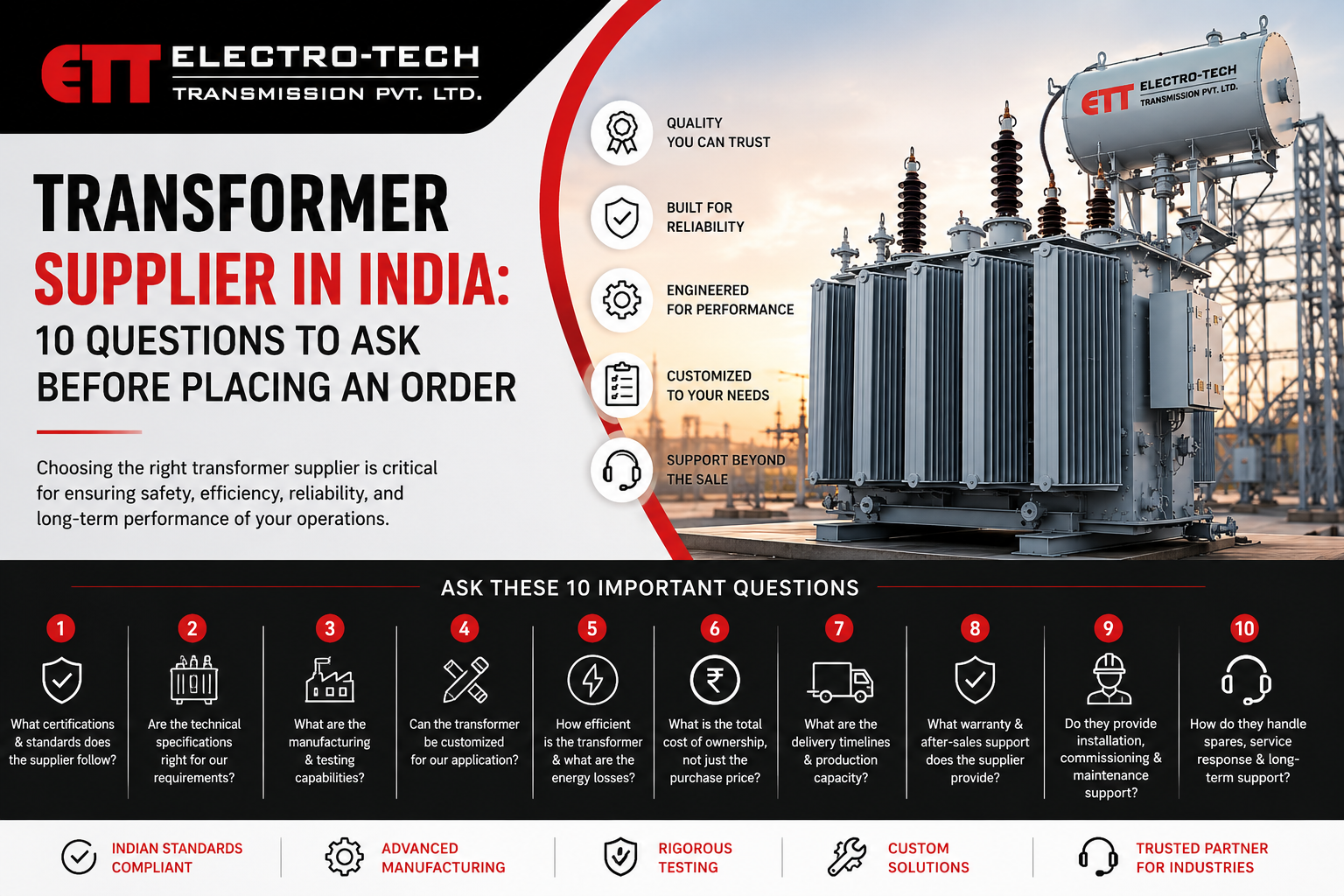
Before placing an order with a Transformer Supplier in India, industrial buyers should verify much more than transformer capacity and price. The supplier should be able to clearly document the proposed transformer’s technical specifications, applicable standards, manufacturing and testing capabilities, guaranteed losses, delivery commitments, warranty terms, and after-sales responsibilities.
For procurement managers, EPC contractors, electrical consultants, plant managers, and project engineers, asking the right questions before issuing a purchase order can prevent specification mismatches, unexpected project delays, higher operating costs, and disagreements over testing or warranty responsibilities.
The following 10 questions provide a practical framework for evaluating transformer quotations and suppliers.
What Should I Ask a Transformer Supplier Before Placing an Order?
Before ordering a transformer, ask the supplier about the exact technical specification, applicable Indian Standards and BIS requirements, manufacturing capability, testing procedures, project experience, customization options, guaranteed losses, delivery schedule, warranty, and after-sales support. These details should be documented in the technical and commercial offer before the purchase order is finalized.
Here is a quick overview:
| # | Question | Why It Matters | What to Verify |
|---|---|---|---|
| 1 | What transformer do you recommend? | Prevents incorrect selection | Application, load, capacity, voltage |
| 2 | Which standards apply? | Establishes compliance basis | IS standard, BIS requirement/licence |
| 3 | What specifications are guaranteed? | Prevents technical mismatch | kVA, voltage, impedance, vector group |
| 4 | Where and how is it manufactured? | Helps assess production capability | Infrastructure and quality control |
| 5 | What tests will be performed? | Verifies performance | Routine/type/special tests and FAT |
| 6 | Can it be customized? | Addresses unusual applications | Engineering and design capability |
| 7 | What losses are guaranteed? | Affects operating cost | No-load and load losses |
| 8 | Have you supplied similar projects? | Indicates relevant experience | References and application experience |
| 9 | What is the committed delivery date? | Protects project schedule | Manufacturing capacity and lead time |
| 10 | What happens after delivery? | Determines lifecycle support | Warranty, commissioning and service |
10 Questions to Ask a Transformer Supplier Before Placing an Order
1. What Transformer Type and Capacity Do You Recommend for Our Application?
A supplier should recommend transformer capacity only after understanding the application’s load profile, connected load, maximum demand, voltage requirements, future expansion, duty cycle, harmonics, motor loads, site conditions, and other relevant operating characteristics. Transformer selection should not be based solely on the present connected load.
Provide accurate project information before requesting a recommendation.
Important inputs can include:
- Required kVA/MVA
- Primary voltage
- Secondary voltage
- Frequency
- Connected and expected maximum load
- Load characteristics
- Motor starting requirements
- Harmonic-producing equipment
- Future expansion
- Indoor or outdoor installation
- Ambient temperature
- Altitude where relevant
- Space limitations
- Application type
The application also determines the transformer category.
An industrial distribution network may require a distribution transformer, while higher-capacity applications may require a power transformer. Certain indoor installations may favor a dry-type transformer, while foundries and metal-processing applications can have specialized requirements associated with furnace transformers.
A transformer’s kVA rating indicates capacity, but capacity alone does not determine whether it is technically suitable for an industrial application.
2. Which Indian Standards and BIS Requirements Apply to This Transformer?
Ask the supplier to identify the exact Indian Standard applicable to the proposed transformer and whether that specific product category is subject to compulsory BIS certification. Buyers should verify applicable certification or licence details rather than relying on a general statement that a transformer is “BIS compliant.”
IS 2026 is the principal Indian Standards series dealing with power transformers. Different parts address subjects including general requirements, temperature rise, insulation levels and dielectric tests, short-circuit withstand, loading, and particular transformer categories.
IS 1180 applies to specified categories of distribution transformers. For example, IS 1180 (Part 1):2014 covers outdoor mineral-oil-immersed distribution transformers up to and including 2,500 kVA and 33 kV.
However, buyers should not assume that the same requirement applies to every transformer.
The correct question is:
“Which standard and certification requirements apply to the exact transformer you are quoting?”
The Bureau of Indian Standards maintains information on products covered by compulsory certification. Buyers can use BIS resources to check current requirements and should verify relevant licence details where certification is mandatory.
ETT also provides its applicable certification and compliance information, which buyers can review when assessing a quotation.
3. What Technical Specifications Are Guaranteed in Your Offer?
The technical offer should clearly state the transformer’s guaranteed rating and electrical parameters rather than relying on a generic product description. Buyers should verify capacity, voltage ratio, frequency, impedance, vector group, tapping arrangement, cooling method, insulation requirements, temperature-rise limits, accessories, and installation conditions where applicable.
At minimum, examine:
- Rated capacity in kVA/MVA
- Primary voltage
- Secondary voltage
- Frequency
- Number of phases
- Vector group
- Percentage impedance
- Tap range and steps
- Tap-changing mechanism
- Cooling method
- Insulation system
- Temperature-rise requirements
- Applicable standard
- Required accessories
For voltage adjustment, determine whether the project requires an off-load tap-changing transformer or an on-load tap-changing transformer.
Do not allow major specifications to remain as assumptions.
They should appear in the approved technical datasheet or drawing before manufacturing begins.
4. What Manufacturing and Quality-Control Capabilities Do You Have?
A transformer supplier should be able to explain where the transformer is manufactured, what production infrastructure is available, which quality-control procedures are followed, and how materials and manufacturing stages are inspected. This is particularly important when the supplier is also the Transformer Manufacturer in India responsible for producing the equipment.
Depending on transformer construction, manufacturing involves multiple controlled processes involving the magnetic core, windings, insulation, tank or enclosure, connections, cooling system, accessories, drying, assembly, and final testing.
Industrial buyers can request information about:
- Manufacturing location
- Production capacity
- Quality-control checkpoints
- Material inspection
- Winding and core manufacturing
- Drying and insulation processes
- Oil handling where applicable
- Tank fabrication
- Final assembly
- Testing infrastructure
- Traceability and documentation
A factory visit can be appropriate for large projects or strategically important orders.
Buyers evaluating ETT can review its manufacturing infrastructure as part of this due-diligence process.
5. What Transformer Tests Will Be Performed Before Dispatch?
Ask the supplier which routine tests will be performed on the ordered transformer, which relevant type-test documentation is available, whether special tests are required by the specification, and whether Factory Acceptance Testing can be witnessed. Testing requirements should be agreed before manufacturing rather than discussed only before dispatch.
Depending on the applicable transformer standard and specification, routine testing may include checks relating to:
- Winding resistance
- Voltage ratio
- Phase displacement/vector group
- Impedance
- Load loss
- No-load loss
- Dielectric performance
- Insulation
- Functional operation
Type and special testing requirements depend on the transformer, applicable standard, purchaser specification, and project.
For significant industrial or EPC projects, buyers may also request a Factory Acceptance Test (FAT).
FAT allows the purchaser, consultant, or authorized representative to witness agreed tests before dispatch.
Ask:
“Which tests are included in the quotation, which tests cost extra, and which test reports will we receive?”
This prevents disagreements later.
6. Can You Customize the Transformer for Our Application and Site?
Customization may be necessary when standard transformer designs cannot meet unusual voltage requirements, specialized loads, space constraints, environmental conditions, tapping requirements, monitoring needs, renewable-energy interfaces, or industry-specific duty cycles. The supplier should explain what can be customized and how the proposed design addresses the requirement.
Not every project needs a custom transformer.
However, specialized requirements can arise in:
- Manufacturing plants
- Foundries
- Renewable-energy projects
- Commercial developments
- Healthcare facilities
- Heavy engineering
- Restricted-space installations
For example, a foundry may have electrical loads and duty requirements substantially different from those of a normal commercial facility.
Similarly, solar power installations may have project-specific voltage and system-integration requirements.
Customization should be based on engineering requirements—not simply the desire for a non-standard product.
7. What Are the Guaranteed No-Load and Load Losses?
Ask for guaranteed no-load and load-loss values because transformer energy losses contribute to operating costs throughout service life. Two transformers with similar purchase prices and ratings can have different lifecycle costs if their loss characteristics differ under the facility’s actual loading conditions.
No-load loss occurs while the transformer is energized and is primarily associated with its magnetic core.
Load loss occurs when current flows through the transformer and varies with loading.
Consider a simplified hypothetical comparison:
| Transformer A | Transformer B | |
|---|---|---|
| Purchase price | ₹10.0 lakh | ₹10.4 lakh |
| No-load loss | Lower | Higher |
| Load loss at rated condition | Lower | Higher |
| Initial price advantage | — | ₹40,000 more |
The ₹40,000 difference alone does not tell the buyer which transformer is economically preferable.
To compare properly, the facility needs the actual guaranteed loss values, expected loading profile, operating hours, electricity cost, maintenance requirements, and anticipated service period.
The lower-priced transformer could ultimately cost more to operate—or it could remain the more economical option. The calculation depends on the actual data.
Purchase price and lifecycle cost are not the same thing.
This is particularly relevant when evaluating energy-efficient transformers for continuously operating industrial facilities.
8. Have You Supplied Transformers for Similar Industrial Applications?
Relevant project experience helps establish whether the supplier understands the electrical, operational, documentation, and execution requirements associated with your industry. Buyers should ask for appropriate project references rather than relying only on the total number of transformers a supplier claims to have produced.
A supplier experienced primarily in standard distribution applications may not necessarily have the same expertise in:
- Furnace duties
- Renewable-energy projects
- Heavy manufacturing
- Healthcare infrastructure
- High-capacity power transformers
- Specialized engineering applications
Ask about:
- Similar transformer ratings
- Similar industries
- Comparable voltage classes
- Specialized applications
- Previous EPC projects
- Geographic service capability
Project experience should be one evaluation factor rather than an automatic guarantee of future performance.
9. What Is the Realistic Manufacturing and Delivery Timeline?
Ask for a documented manufacturing lead time and committed delivery schedule that accounts for engineering approval, material procurement, production, testing, inspection, and dispatch. Buyers should also confirm whether drawing approvals or customer inspections can affect the promised delivery date.
“Delivery in eight weeks” can mean different things.
Eight weeks from:
- Purchase order?
- Advance payment?
- Approved technical specification?
- Drawing approval?
- Release for manufacturing?
Clarify this before finalizing the order.
For project-critical transformers, ask:
- When will drawings be submitted?
- How long is manufacturing expected to take?
- Is material already available?
- When will testing occur?
- How much notice is required for FAT?
- When is dispatch expected?
- What circumstances can change the schedule?
An unusually short delivery promise should be evaluated against actual manufacturing capacity and project requirements.
10. What Warranty and After-Sales Support Do You Provide?
Transformer evaluation should continue beyond delivery. Buyers should understand warranty duration, exclusions, claim procedures, technical support, commissioning responsibilities, repair arrangements, spare-parts availability, service response, and who bears transportation or site costs when warranty work is required.
Ask the supplier:
- When does the warranty begin?
- How long does it last?
- What components are covered?
- What conditions void the warranty?
- What is the claim procedure?
- Is installation supervision available?
- Is commissioning support included?
- Who investigates site failures?
- Are technicians available for field support?
- What spare parts should be stocked?
- What happens if repair requires factory return?
- Who bears transportation costs?
A long warranty statement is less useful if the process for obtaining support is unclear.
For industrial plants, after-sales capability can be especially important because transformer-related downtime may affect production.
Why Should Buyers Be Careful With Unusually Low Transformer Quotations?
An unusually low quotation should trigger technical comparison rather than immediate rejection or acceptance. Check whether suppliers are quoting the same materials, ratings, accessories, guaranteed losses, testing, standards, warranty, delivery scope, and services. A lower price may simply reflect a different technical or commercial scope.
Create a bid-comparison sheet before choosing a supplier.
Compare:
Technical compliance → guaranteed losses → materials/specification → testing → accessories → delivery → warranty → services → price
Only then are the quotations genuinely comparable.
Transformer Purchase Order Checklist
Before issuing the PO, request and confirm:
- ☐ Final technical datasheet
- ☐ Transformer rating and voltage ratio
- ☐ Vector group and impedance
- ☐ Tap range and tap changer
- ☐ Cooling method
- ☐ Applicable Indian Standard
- ☐ Relevant BIS information where required
- ☐ Guaranteed no-load and load losses
- ☐ General arrangement drawing where applicable
- ☐ Approved accessories list
- ☐ Routine testing requirements
- ☐ Relevant type-test documentation
- ☐ Special tests where specified
- ☐ FAT/witness-testing requirements
- ☐ Commercial quotation
- ☐ Taxes and freight responsibilities
- ☐ Payment terms
- ☐ Manufacturing lead time
- ☐ Committed delivery terms
- ☐ Warranty conditions
- ☐ Installation/commissioning scope
- ☐ After-sales responsibilities
The purchase order should incorporate the final agreed technical specification rather than referring only to a model number.
Choosing a Transformer Supplier in India should be treated as a technical procurement decision, not simply a price negotiation.
Before placing an order, verify three things in particular:
What exactly are we buying?
How will its compliance and performance be demonstrated?
What happens if there is a problem after delivery?
A reliable supplier evaluation therefore considers technical suitability, applicable standards, manufacturing and testing, guaranteed losses, customization, relevant experience, delivery capability, warranty, and lifecycle support alongside the initial quotation.
Whether sourcing Industrial Distribution Transformers in India, specialized transformers, or equipment for a new industrial project, asking these 10 questions gives procurement and engineering teams a more structured basis for comparing suppliers before committing capital.
Frequently Asked Questions
What documents should I request from a transformer supplier before ordering?
Request the technical datasheet, applicable drawings, compliance information, guaranteed loss data, agreed test requirements, relevant type-test documentation, commercial terms, delivery commitment, warranty conditions, and installation or commissioning scope where applicable.
How can I verify whether a transformer supplier has BIS certification?
First determine whether compulsory BIS certification applies to the exact transformer category. Where it does, request the supplier’s licence details and verify the relevant information through official BIS resources rather than relying solely on marketing claims.
What technical information should I provide when requesting a transformer quotation?
Provide the required capacity, primary and secondary voltages, frequency, load characteristics, installation environment, expected loading, future expansion, tapping requirements, site conditions, applicable standards, required accessories, and testing requirements.
Should I choose the transformer supplier offering the lowest quotation?
Not automatically. First confirm that every supplier is quoting an equivalent technical scope. Compare ratings, materials, guaranteed losses, accessories, testing, warranty, delivery, and support before comparing the final price.
What is FAT in transformer procurement?
Factory Acceptance Testing is an agreed pre-dispatch inspection and testing process that may allow the purchaser, consultant, or representative to witness specified transformer tests and verify results against the approved requirements.
Why are no-load and load losses important when buying a transformer?
No-load and load losses represent energy dissipated during transformer operation. Because transformers can remain in service for many years, these losses can contribute materially to operating costs. Buyers should therefore consider guaranteed losses alongside purchase price.