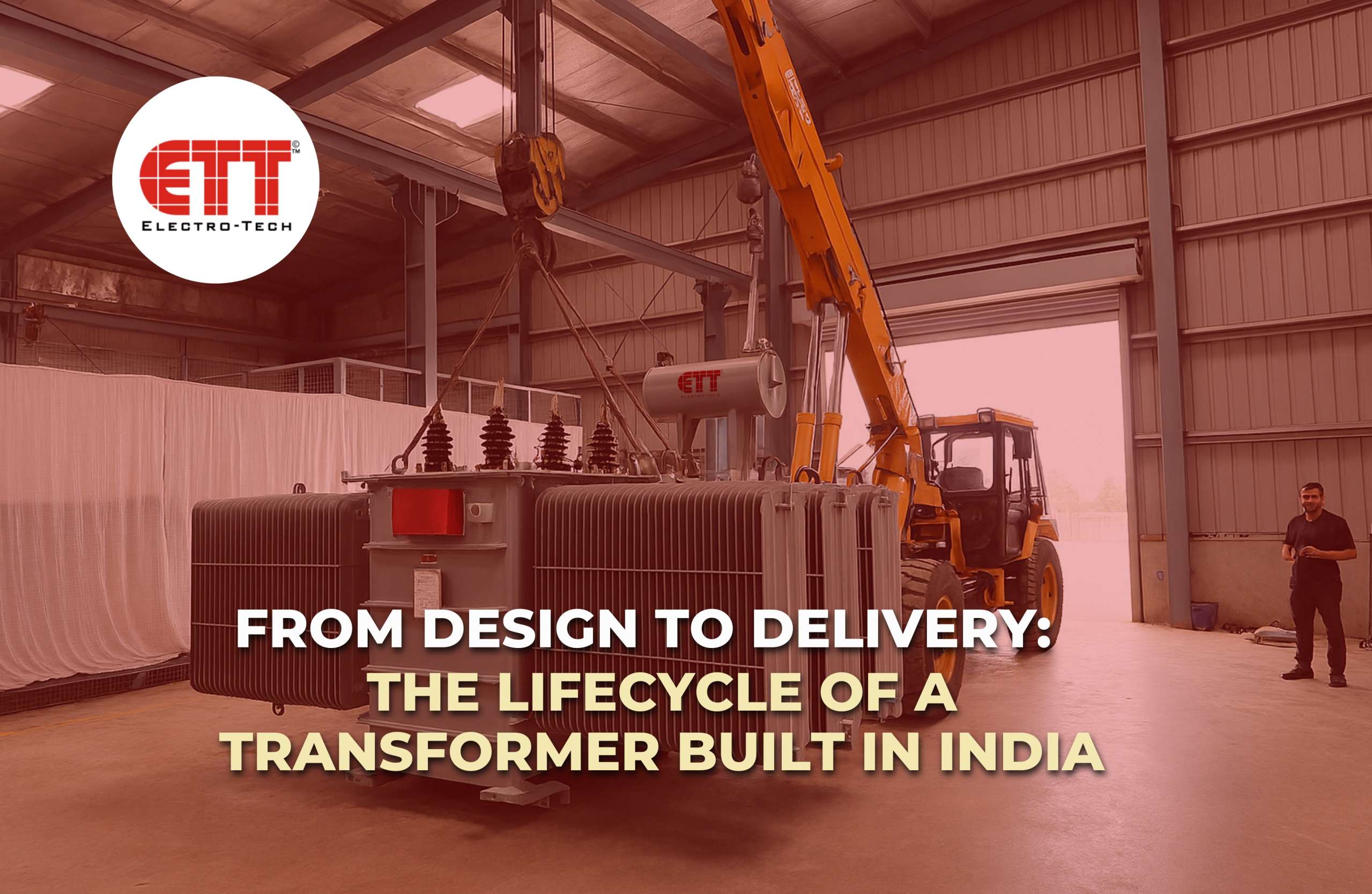
From Design to Delivery: The Lifecycle of a Transformer Built in India

Transformer Built in India August 23 2025

India’s rapid industrial growth, urban development, and clean energy ambitions have made transformers a fundamental pillar of power infrastructure.

These complex machines enable safe, efficient transmission of electricity across sectors and regions. But behind every reliable transformer lies an intricate lifecycle—from design to delivery—that ensures durability, efficiency, and performance.

In this blog, we explore the full lifecycle of a transformer manufactured in India, showcasing how Indian manufacturers are meeting global standards through innovation, precision engineering, and stringent quality control. Whether powering metro cities, rural grids, solar parks, or manufacturing zones, transformers built in India are designed to last.

1. Concept and Requirement Gathering

Every transformer begins with a clear understanding of its application. Clients—whether power utilities, industrial plants, or renewable energy developers—approach manufacturers with specifications based on:

  • Voltage and current requirements
     
  • Environmental conditions (temperature, humidity, altitude)
     
  • Cooling type (oil or dry type)
     
  • Load profile (steady or fluctuating)
     
  • Safety and compliance standards
     

Indian manufacturers conduct a needs analysis to align design parameters with operational realities. This step is crucial to avoid overdesign or underperformance.

2. Engineering and Design Phase

Design is one of the most crucial stages, as it determines the transformer’s efficiency, longevity, and resilience. Here’s how it unfolds:

  • CAD Modeling and Simulation: Engineers use advanced CAD platforms and simulation tools to digitally prototype the core, winding arrangements, cooling systems, and tank structure.
     
  • Efficiency Enhancement: Electrical and thermal modeling is used to minimize both no-load and load losses effectively.
     
  • Precision Material Selection: Core and winding materials are carefully chosen according to the voltage level, frequency range, and intended industrial use.
     

At this stage, Indian manufacturers also factor in mechanical robustness, seismic conditions, and insulation strength. The result is a design blueprint tailored for the transformer’s operating environment.


3. Procurement of Raw Materials

Transformers rely on high-grade materials to perform efficiently:

  • Core Material: Laminated CRGO (Cold Rolled Grain Oriented) steel is used to minimize eddy current losses.
     
  • Winding Conductor: High-conductivity copper or aluminum, often enamel-coated.
     
  • Insulating Materials: Pressboard, Kraft paper, and mineral oil or ester fluid for insulation and cooling.
     
  • Structural Materials: Mild steel or stainless steel for tanks and structural supports.
     

Reputed Indian manufacturers conduct vendor evaluations, third-party certifications, and audits to ensure raw materials meet IS, IEC, or ANSI standards.

4. Core Assembly and Coil Winding

After procurement, production begins. It involves:

  • Core Building: Laminated steel sheets are stacked with precision and clamped for optimal magnetic flux.
     
  • Coil Winding: Conductors are wound into HV (High Voltage) and LV (Low Voltage) coils using automated machines for uniformity.
     
  • Insulation: Each layer is insulated to withstand thermal and electrical stress.
     

Manufacturers ensure dimensional accuracy and tension control to prevent hotspots, partial discharges, or winding deformation.

5. Core-Coil Assembly

Once the coils are ready, they are assembled onto the magnetic core:

  • Vertical or Horizontal Mounting: Depending on design
     
  • Drying in Vacuum Oven: Removes moisture for optimal dielectric strength
     
  • Bracing and Clamping: Ensures mechanical stability
     

At this stage, manufacturers also insert sensors for temperature and pressure monitoring.

6. Tank Fabrication and Final Assembly

  • Tank Construction: Steel plates are cut, shaped, and welded to create the transformer’s outer tank with high precision.
     
  • Cut, bent, and welded to precise dimensions
     
  • Fitted with radiators, conservator tanks, and bushings
     
  • Coated with anti-corrosion primer and paint
     

The core-coil assembly is lowered into the tank, oil is filtered and filled, and accessories like OLTCs, CTs, and cooling fans are integrated.

7. Testing and Quality Assurance

Every transformer goes through comprehensive testing before dispatch. These include:

Type Tests:

  • Lightning impulse
     
  • Temperature rise test
     
  • Short-circuit withstand test
     

Routine Tests:

  • Ratio and polarity test
     
  • Winding resistance
     
  • Insulation resistance
     
  • Oil breakdown voltage
     

Special Tests (on demand):

  • Partial discharge
     
  • Harmonic analysis
     
  • Noise level measurement
     

Indian manufacturers maintain detailed test records and comply with ISO 9001, ISO 14001, and IEC norms.

8. Packaging and Dispatch

Transformers are packed to withstand harsh transport conditions:

  • Vacuum-sealed or nitrogen-filled for export
     
  • Wooden or steel-framed pallets
     
  • Shock sensors and moisture indicators
     

Indian exporters follow IMDG, ISPM-15, and maritime regulations for safe global shipments.

9. Installation and Commissioning

Upon delivery, manufacturer engineers assist in:

  • Site inspection
     
  • Mounting and connections
     
  • Oil filtration and gas analysis
     
  • Load testing
     

They also train operators in safe handling, routine checks, and preventive maintenance.

10. After-Sales Support and Monitoring

Support doesn’t end with installation. Indian transformer companies offer:

  • Remote monitoring systems (SCADA, IoT sensors)
     
  • AMC contracts
     
  • Troubleshooting and repair
     
  • Spare part logistics
     

This helps clients maximize uptime and asset life.

Why Indian Manufacturers Stand Out

  • India’s Global Reputation: India has evolved beyond a manufacturing base—today, it stands as a reliable partner in the global transformer supply chain.
     
  • R&D Capabilities: Collaborations with IITs and national labs drive continuous innovation.
     
  • Tailored Engineering: Bespoke solutions are developed for applications like renewable energy, intelligent power grids, and advanced industrial systems
     
  • Certifications: CE, BIS, ISO, and IEC compliance
     
  • Global Reach: Strong supply chains across Asia, Africa, Middle East, and Europe
     
  • Sustainability Focus: Eco-friendly insulation fluids, recyclable materials, and energy-efficient designs
     

The journey of a transformer—from drawing board to grid—is long, detailed, and technology-intensive. Indian tranformer manufacturers have mastered this lifecycle with world-class engineering, rigorous quality systems, and an unwavering commitment to customer satisfaction.

As energy demand surges and renewables reshape the power landscape, transformers made in India will continue to energize homes, industries, and nations. Whether you’re looking for distribution, power, or special-purpose transformers, Indian manufacturers deliver end-to-end excellence.

whatsapp Icon